Augmented Reality · 3 min read
Advantages of Augmented Reality in the Beauty Industry
Virtual try-on and AR experiences are transforming how beauty brands let customers test shades and products.
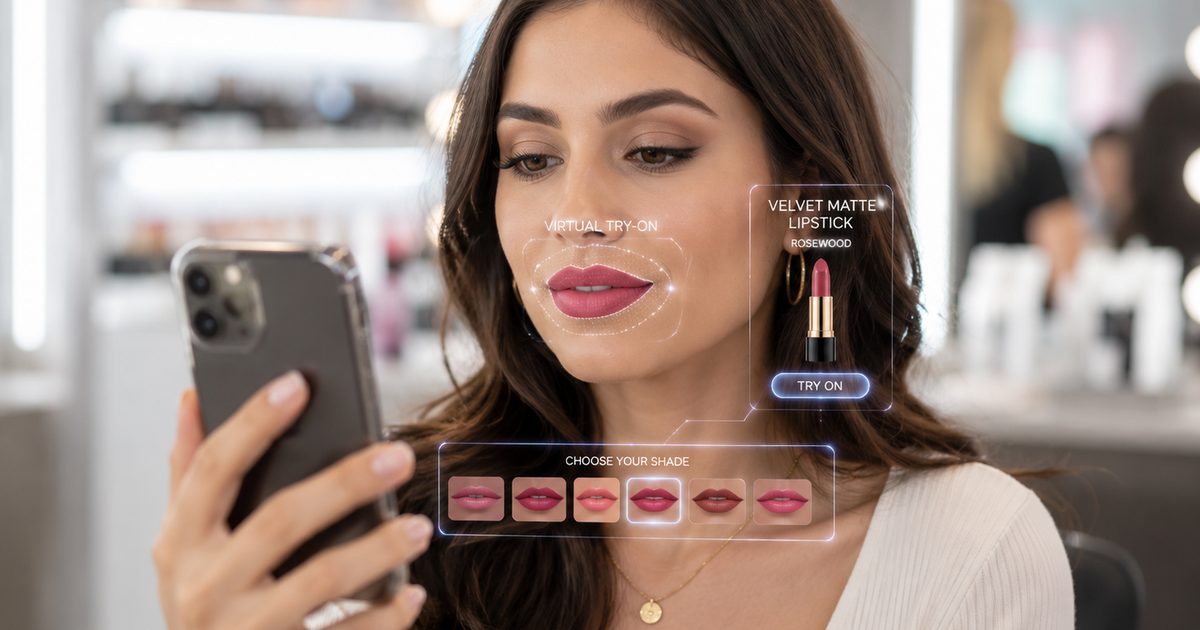
The beauty industry has always been built on the moment of try-before-you-buy. Physical testers in stores, beauty consultants applying products, sample sachets tucked into orders — all of it exists to overcome the same barrier: how does this actually look on me? Augmented reality has answered that question at scale, and in doing so it is reshaping how beauty brands market, sell, and retain customers.
Virtual Try-On: Beyond the Gimmick
Early AR beauty experiences were rough approximations — flat colour overlays that barely tracked the face. That era is over. Today's virtual try-on uses real-time facial mesh mapping, accurate colour rendering across different skin tones and lighting conditions, and physics-based simulation of textures like glitter or matte finishes. The experience is close enough to the real product that it genuinely informs purchase decisions.
Global beauty giants have validated this commercially: brands report 2.5× higher conversion rates on products with AR try-on enabled, and return rates drop significantly when customers buy with confidence rather than guessing. For the Indonesian market — where online beauty sales have grown more than 35% year-on-year — this is a meaningful competitive advantage.
Key Applications for Beauty Brands
- Lip and eye colour try-on – The most mature application. Customers select a shade and see it rendered on their live camera feed in real time. Can be embedded in an e-commerce product page, shared as a link, or deployed as an Instagram filter.
- Foundation shade matching – AI analyses the customer's skin tone from the camera and recommends the closest shade from the product range. Reduces the most common beauty return: "the colour looked different online."
- Skincare simulation – Before-and-after visualisations show the projected effect of a skincare regimen over time, addressing the longstanding challenge that skincare results are invisible until weeks after purchase.
- Eyewear and accessories – Glasses frames, earrings, and hair accessories can be tried on virtually, with accurate scale and movement tracking as the customer turns their head.
- AR packaging – Scanning a product box triggers tutorial videos, ingredient explanations, or loyalty mechanics — extending the brand relationship beyond the point of sale.
Distribution: Where AR Meets the Customer
The beauty industry's AR distribution strategy is maturing quickly. WebAR (no app required) can be embedded directly in product detail pages on Tokopedia, Shopee, or a brand's own website. QR codes on physical packaging or in-store POP material bridge offline and online. Social platforms including TikTok and Instagram provide built-in AR camera effects that reach millions of users organically.
For Indonesian brands, WhatsApp is an especially powerful distribution channel — an AR try-on link can be sent directly to a customer's phone by a beauty advisor or chatbot, delivering a personalised experience at scale without requiring any additional infrastructure.
Building an AR Experience for Your Beauty Brand
The scope of an AR project depends on how many products are involved, the fidelity of colour rendering required, and the channels where the experience will live. A single-product WebAR try-on can be live within a few weeks; a full-catalogue virtual counter with social integration is a longer engagement.
InReality Solutions works with beauty and personal care brands across Indonesia to design, develop, and deploy AR experiences that convert. Talk to our team to explore what AR could look like for your product range.

Content Specialist, InReality Solutions
Ready to Build Your New Reality?
Tell us about your brand and goals — we'll show you what's possible.