AR/VR · 3 min read
AR and VR for Training and Learning: A Practical Enterprise Guide
How Indonesian enterprises are using AR and VR to train workforces more effectively — with lower cost, better retention, and no operational disruption.
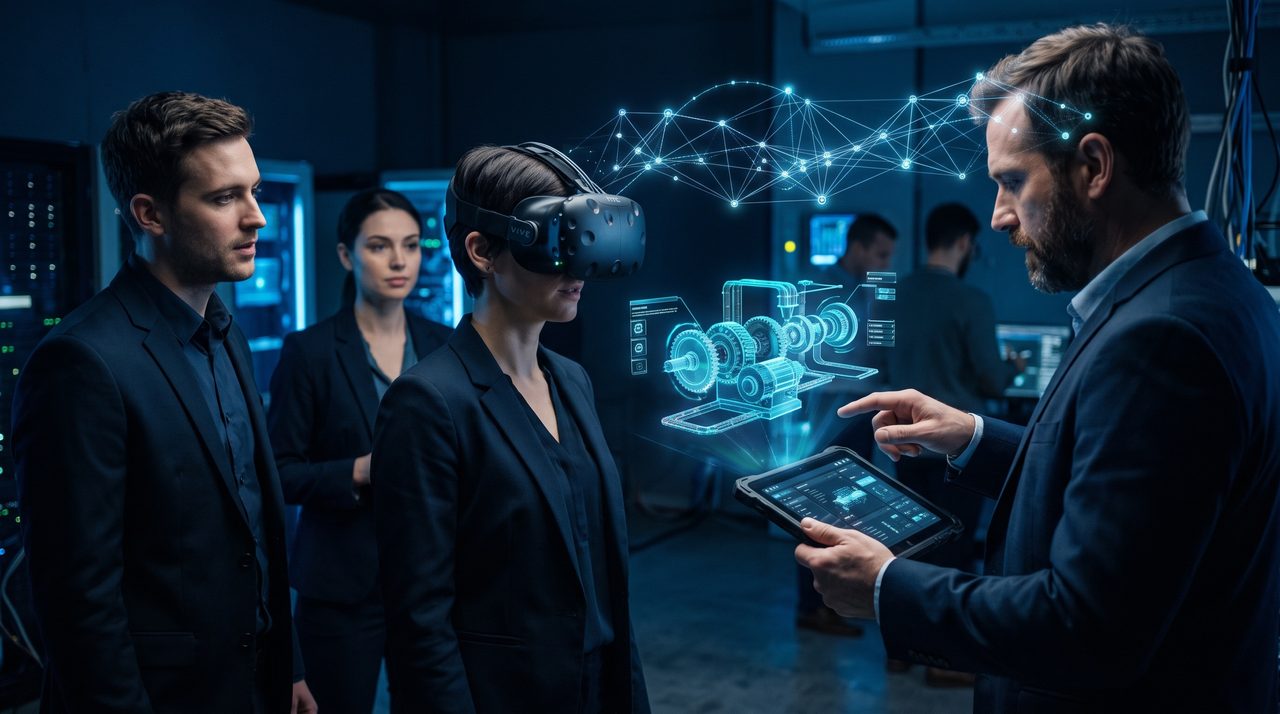
Enterprise training has a performance problem. The traditional model — classroom instruction, printed manuals, e-learning modules, occasional on-the-job coaching — produces knowledge that dissipates quickly and does not consistently translate into changed behaviour. Studies consistently show that most of what is taught in a standard training session is forgotten within a week. For skills that are infrequently practised, like emergency response or rare machine maintenance procedures, the decay is even faster.
AR and VR address this problem at its root by replacing instruction with experience. The learning that matters — the kind that changes behaviour under pressure — comes from doing, not watching or reading. Immersive technology creates the doing in a safe, controlled, repeatable environment.
AR for Training: Guidance in the Work Environment
Augmented reality is most powerful for training in the context of real work. Instead of asking a new employee to memorise a procedure and then apply it in the field, AR overlays step-by-step guidance directly onto the actual equipment or environment they are working with — through smart glasses or a smartphone camera.
Practical AR training applications in Indonesian enterprises include:
- Assembly and maintenance procedures — AR guides technicians through complex assembly sequences on real machinery, highlighting the next step, flagging potential errors, and confirming correct execution before moving on.
- Quality control — AR overlays tolerance specifications onto physical components, allowing inspectors to compare against standards in real time rather than consulting separate reference documents.
- Spatial orientation — In large facilities, AR wayfinding guides new employees to specific locations, equipment, or emergency exits — reducing the time and error rate of initial orientation.
- Remote expert support — A field technician facing an unfamiliar problem shares their AR view with a remote expert, who can annotate the view with instructions visible to the technician in real time.
VR for Training: High-Stakes Simulation
Virtual reality is most valuable for training scenarios where real-world practice is too dangerous, too expensive, or too disruptive to carry out regularly. The quality of the simulation — its visual fidelity, its audio environment, its behavioural accuracy — directly determines the quality of the training, which is why production investment matters.
High-value VR training applications for Indonesian enterprises:
- Emergency response — Fire evacuation, chemical spill response, medical emergency protocols — trainees experience the scenario at full stress, make real-time decisions, and learn from the consequences without risk.
- Hazardous equipment operation — Operating heavy machinery, electrical work, or working at height — VR allows operators to build procedural fluency before touching real equipment.
- Leadership and crisis management — VR scenario-based simulations place managers in crisis situations — a public incident, a media confrontation, a team conflict — allowing them to practise responses that cannot be rehearsed any other way.
- Customer service and sales — Role-play simulations allow sales and service staff to practise difficult conversations, objection handling, and complaint resolution in a realistic context.
Measuring the Return on Training Investment
The commercial case for AR/VR training rests on three economic arguments. First, delivery cost at scale: once a module is built, deploying it to 100 or 10,000 trainees costs the same. Second, performance improvement: higher retention rates, lower error rates in the field, and measurable competency gaps that traditional training misses. Third, operational continuity: training delivered without pulling staff from their workstations, requiring travel, or shutting down production lines.
Indonesian enterprises that have quantified their AR/VR training ROI typically find payback within 12–24 months for programmes with more than 200 annual training instances — and faster for high-risk or compliance-critical applications where the cost of training failure is significant.
Implementation Roadmap
Most organisations begin with a single, high-value training use case — typically the procedure with the highest risk of error, the most frequent occurrence, or the most difficult delivery logistics. A pilot programme covering one module and one cohort allows the organisation to measure performance, gather user feedback, and build the internal capability to expand.
InReality Solutions designs and delivers AR and VR training solutions for Indonesian enterprises across manufacturing, healthcare, hospitality, property, and corporate sectors. Learn about our VR solutions or contact our team to discuss your training programme.
Frequently Asked Questions
How do AR and VR improve enterprise training outcomes?
AR and VR replace passive instruction with active experience — which produces significantly better knowledge retention and behaviour change. VR creates high-fidelity simulations of scenarios too dangerous or disruptive to practice in reality. AR delivers guidance in the actual work environment, reducing error rates during and after training.
What is the ROI of AR/VR training for businesses?
Enterprises with programmes running 200+ annual training instances typically see payback within 12–24 months. Key value drivers are: lower per-trainee delivery cost at scale, reduced error rates and associated costs in the field, improved compliance and reduced incident frequency, and elimination of operational disruption from traditional training delivery.
What types of training work best with AR versus VR?
AR excels at in-context procedural guidance — assembly, maintenance, quality control, wayfinding — where the trainee is in the real environment and needs step-by-step overlay instructions. VR excels at simulation-based training — emergency response, hazardous equipment, crisis management, complex soft skills — where realistic but safe scenario immersion is needed.
How long does it take to implement a VR or AR training programme?
A single VR training module typically takes 8–14 weeks to develop from brief to deployment, depending on environment complexity and interaction requirements. AR procedural guides can be faster, particularly where the work environment is standardised and well-documented. Most organisations pilot one module before scaling.

Founder & Managing Director · LinkedIn
Ready to Build Your New Reality?
Tell us about your brand and goals — we'll show you what's possible.