- Home
- Blog
- AI Automation for Manufacturing in Indonesia: Protecting Margins While the PMI Stays Below 50
AI Automations · 6 min read
AI Automation for Manufacturing in Indonesia: Protecting Margins While the PMI Stays Below 50
Indonesia's manufacturing PMI has spent most of 2026 hovering near or below the 50-point line. Here's what the data actually shows, and where AI process automation genuinely helps manufacturers protect margins without cutting output.
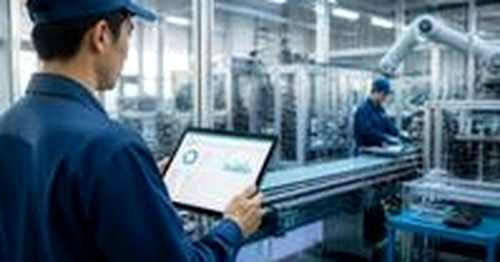
Indonesia's S&P Global Manufacturing PMI came in at 49.8 in August 2026 — down from a five-month high of 50.2 in July, and still recovering from a one-year low of 46.9 in June. Any reading below 50 means new orders and output are contracting compared with the month before. This isn't a single bad month; it's a sector that has spent most of the year oscillating around the line between growth and contraction.
For a manufacturer sitting inside that number, the question isn't really about the index. It's about what to do when demand is softer, input costs are rising at the fastest pace since 2013, and the fixed cost of running the business hasn't gone anywhere. This is where AI process automation earns a real look — not as a buzzword, but as one of the few cost levers a manufacturer can pull without cutting headcount or waiting on a government cycle.
What the PMI data is actually saying
The contraction in June 2026 was Indonesia's sharpest in a year, driven by a renewed decline in new orders — the first drop in total demand in three months, and the fastest pace of decline in a year. New export orders fell at their steepest rate since August 2021, as higher prices made Indonesian goods less competitive abroad. On the cost side, input price inflation hit its highest level since September 2013, with manufacturers pointing to surging raw material prices as the primary driver.
July's rebound to 50.2 offered brief relief, but August's slip back to 49.8 suggests the underlying pressure hasn't cleared. None of this means factories are shutting down — it means margins are thinner than they were a year ago, and they're likely to stay that way for a while.
A sector that was already carrying structural cost
The PMI pressure is landing on a sector with cost problems that predate 2026. Manufacturing still contributes an estimated 18.9% of Indonesia's GDP and employs around 18 million people — roughly 14% of the national workforce — but that share has eroded steadily, down from about 32% of GDP in 2002 to roughly 19% by 2023.
Part of the reason is logistics. Logistics costs are estimated at around 14% of Indonesia's GDP, a figure well above what manufacturers in more developed economies carry, reflecting an archipelago geography and fragmented supply chains that make coordination genuinely harder. Indonesia's Economic Complexity Index also sits around -0.1, a proxy for how sophisticated the country's production base is relative to its trading partners — another way of saying there's real room to close the gap on efficiency, not just on cost.
The automation gap is bigger than the automation appetite
What's interesting is that Indonesian manufacturers don't seem to lack interest in fixing this. One industry analysis of Indonesia's manufacturing sector found that only around 26% of organizations have implemented AI tools at scale, even though as many as 93% describe themselves as confident or ready to adopt it. A separate PwC survey found that 53% of companies hadn't implemented generative AI at all.
The barriers reported are practical, not attitudinal: 81% of enterprises cited data quality issues, and 56% cited difficulty integrating new tools with what they already run. In other words, most manufacturers aren't debating whether to automate — they're stuck on how to start without disrupting a production line and reporting chain that's already stretched thin.
The highest-value places to start, according to the same analysis, tend to be supply chain coordination across fragmented geography, maintenance scheduling, real-time quality checks, and production planning that currently depends on someone manually reconciling spreadsheets across shifts or sites.
Where automation actually pays back fastest
Full line automation — new machinery, robotics, sensor networks — is real and valuable, but it's capital-intensive and slow to plan for, which makes it a poor first move for a manufacturer trying to protect margin this quarter. The faster payback usually sits one layer up, in the process and reporting work that currently runs on someone's memory, a shared spreadsheet, or a WhatsApp group with no record of what was agreed.
In practice that looks like: order confirmations and delivery updates sent automatically instead of chased by phone; daily production or sales numbers pulled into a dashboard instead of retyped into a report every morning; inventory levels that trigger a reorder alert before a line runs out of material; and lead or customer messages routed to the right person the first time, instead of sitting in a shared inbox. None of it requires new machinery on the floor. Most of it runs on tools the business already has — WhatsApp, Google Sheets, or the existing ERP — connected so they talk to each other instead of requiring a person in the middle.
This is deliberately the less exciting half of "AI in manufacturing." It won't make a trade show demo reel. It is, however, the half that a manufacturer under margin pressure can actually fund and deploy in weeks rather than a capital-planning cycle, which matters more when the PMI is telling you the pressure isn't over yet.
A government incentive worth knowing about — and its limits
Manufacturers weighing bigger equipment upgrades should know about Kementerian Perindustrian's Restrukturisasi Mesin dan/atau Peralatan program, administered by Ditjen IKMA. It's aimed mainly at small and medium industrial companies, though larger firms can qualify on a case-by-case basis, and it funds new machinery, production equipment, and supporting systems that improve efficiency, quality, or output — including automated equipment with monitoring or data-capture features, when it's directly attached to a production asset.
The catch is the mechanics: it's a reimbursement, not an upfront grant. A company has to purchase and install the eligible equipment first, then claim back part of the cost once installation is complete — and it runs through limited application windows announced periodically, not continuously. That makes it a genuinely useful tool for planned capital investment, but not something to wait on if the goal is to reduce operational cost this quarter. Software-level process automation doesn't need a grant window to start.
A practical starting point
For a manufacturer that has never automated a process before, the sequence that tends to work is small and measurable rather than ambitious. Pick the one manual task that consumes the most staff hours for the least judgment involved — a daily report, an order confirmation flow, a reorder trigger — automate that single process, and measure the hours it frees up before deciding what's next. That evidence is what makes the case for the second project, and the third, without needing to bet the whole operation on a transformation program up front.
InReality Solutions builds process automation, WhatsApp-based customer and order handling, and reporting dashboards for businesses across Indonesia, including manufacturers navigating exactly this kind of margin pressure. If you're trying to work out which process to automate first, that's a shorter conversation than most people expect. Read more on AI automation services, see our AI consulting approach, or talk to our team in Jakarta.
Frequently Asked Questions
Is Indonesia's manufacturing sector actually shrinking in 2026?
Not shrinking in absolute terms, but under real pressure. S&P Global's Indonesia Manufacturing PMI read 49.8 in August 2026, down from a five-month high of 50.2 in July, after touching a one-year low of 46.9 in June. A reading below 50 signals contraction in new orders and output versus the previous month. Manufacturers surveyed for the index cited weaker demand, thinner consumer purchasing power, and the steepest input-cost inflation since September 2013.
Why are Indonesian manufacturers looking at AI automation now specifically?
Because the PMI pressure is landing on a sector that already carries above-average structural costs. Logistics costs alone are estimated at roughly 14% of Indonesia's GDP, well above the economies Indonesian exporters compete against, and manufacturing's own share of GDP has fallen from about 32% in 2002 to roughly 19% by 2023. When margins tighten on top of that fixed cost base, the practical options are to cut headcount, absorb the hit, or reduce the cost of the manual work that doesn't need a person doing it by hand. Automation is usually the option that doesn't require a hiring freeze or a public announcement to start.
What's actually stopping Indonesian manufacturers from adopting AI automation already?
Mostly integration, not appetite. One industry analysis found that only around 26% of Indonesian organizations have implemented AI at scale, even though as many as 93% describe themselves as confident or ready to adopt it, and a separate PwC survey found 53% of companies hadn't implemented generative AI tools at all. The barriers reported were practical rather than attitudinal: 81% cited data quality problems and 56% cited difficulty integrating new tools with existing systems. That's a gap between intent and execution, not a lack of interest.
Is there government support for manufacturers who want to modernize?
Yes, through Kementerian Perindustrian's Restrukturisasi Mesin dan/atau Peralatan program, run by Ditjen IKMA mainly for small and medium industrial companies, though larger firms can qualify case by case. It works as a reimbursement rather than an upfront grant: a company buys and installs eligible machinery or production equipment first, including automated equipment with monitoring or data-capture features, then claims back part of the cost afterward. It runs through periodic application windows rather than continuously, so it rewards companies that plan the purchase before a window opens — it isn't a substitute for starting smaller, software-only automation in the meantime.
Where should a manufacturer start if they've never automated anything before?
With whichever manual process currently eats the most staff time for the least judgment required — order confirmations, delivery status updates, daily production or sales reporting, and inventory reorder alerts are the common starting points. None of these require new machinery, a capital budget, or a government grant cycle to begin; they're usually built on tools the business already has, such as WhatsApp, spreadsheets, or the existing ERP. Getting one of these live and measured is what builds the case for the next one.

Founder & Managing Director · LinkedIn
Ready to Build Your New Reality?
Tell us about your brand and goals — we'll show you what's possible.