Augmented Reality · 3 min read
The Future of Jewelry Shopping with Augmented Reality
How AR virtual try-on is transforming jewelry retail in Indonesia — letting customers see rings, necklaces, and earrings on themselves before buying.
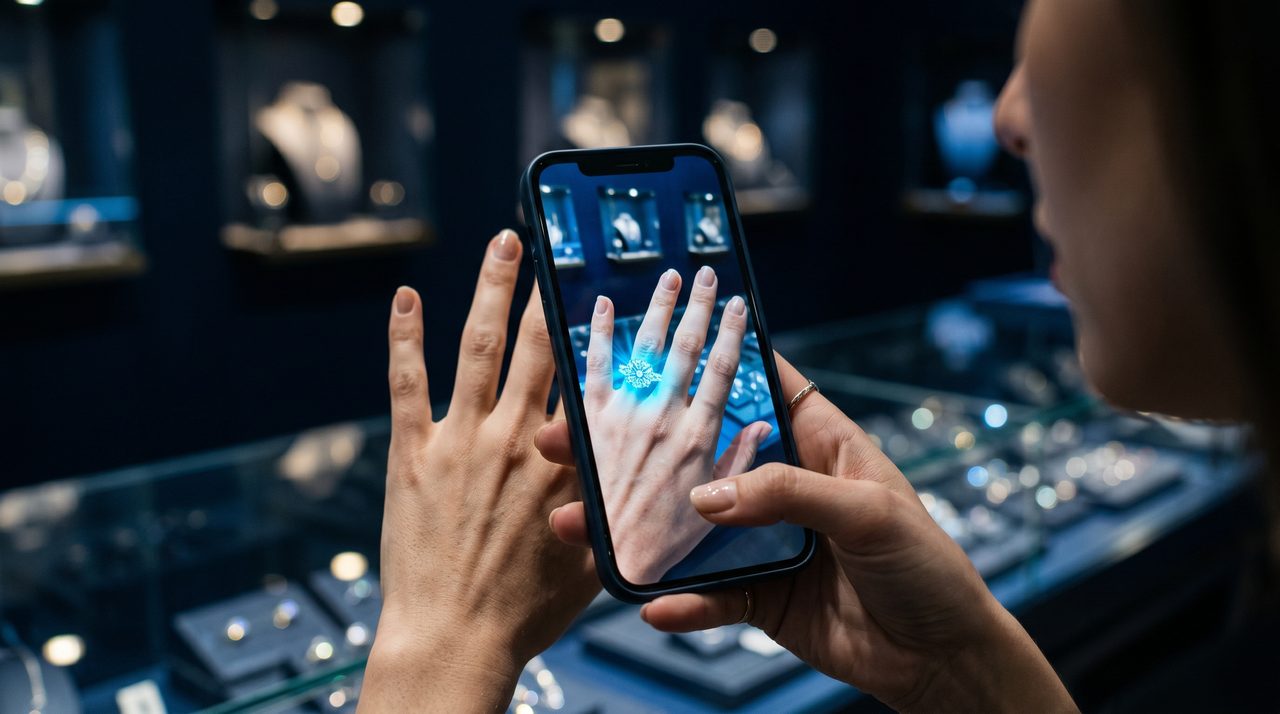
Buying jewelry has always been a tactile, personal act. Holding a ring to the light, trying on a necklace in the store mirror, asking for a second opinion on earrings — these are the micro-moments that turn browsing into buying. For decades, that experience was impossible to replicate online, which is why jewelry remained one of the last major retail categories to shift significantly to e-commerce. Augmented reality has changed that equation, and the Indonesian jewelry market is beginning to feel the impact.
The Problem AR Solves for Jewelry Buyers
The core barrier to online jewelry purchases is not price or trust — it is visualisation. A ring photographed against a white studio background tells a buyer almost nothing about how it will look on their hand. Size, scale, how the metal interacts with their skin tone, how a stone catches the light in different environments — none of this is communicated by a product photo, however professional.
AR solves this directly. Using the front camera, a customer can see a ring rendered on their own finger in real time, in their actual lighting, at accurate scale. They can move their hand, look at it from different angles, and compare multiple styles without removing anything. The experience is not perfect — current AR cannot replicate the weight of metal or the exact play of light in a stone — but it is dramatically better than a photograph at answering the question "will I like how this looks on me?"
Current AR Applications in Jewelry Retail
Ring try-on is the most mature application. Facial and hand-tracking technology has advanced to the point where rings can be placed on a specific finger with accurate proportional scaling, updating in real time as the hand moves. Leading global jewelry brands have reported significant increases in online conversion after implementing AR ring try-on.
Necklace and earring try-on uses facial AR to place jewelry in the correct position relative to the customer's face and neck. The technology requires good front-camera quality and consistent lighting, but modern mid-range smartphones — the dominant device category in Indonesia — are capable of running these experiences smoothly via WebAR.
Bracelet and watch try-on is more technically demanding due to the wrist's movement and three-dimensional shape, but is increasingly viable on platforms that use depth-sensing or advanced hand-tracking.
How Indonesian Jewelry Brands Can Use AR Now
For Indonesian jewelry retailers and brands, the strategic opportunity is to reach buyers where they already are: Tokopedia, Shopee, Instagram, and WhatsApp. WebAR experiences can be embedded directly in product listings, shared as links by sales staff via WhatsApp, or triggered by QR codes in physical stores or print catalogues.
The economics are compelling. A customer who tries on five rings virtually before visiting a store arrives knowing what they want, reducing the sales consultation from a discovery process to a confirmation. A customer shopping online who can try before buying is significantly less likely to return a purchase — and more likely to buy multiple items. One analysis of jewelry categories found that AR try-on increased items-per-order by up to 25%.
What the Future Holds
The near-term future of AR jewelry retail includes AI-powered style recommendation — suggesting rings that complement a customer's skin tone and hand shape — and social AR sharing that lets a customer send a friend a version of the experience to get an opinion. Further ahead, spatial computing platforms will allow customers to examine jewelry in 3D environments at full detail, closing the remaining gap between virtual and physical try-on.
For Indonesian jewelry brands looking to stay ahead of this shift, InReality Solutions builds WebAR try-on experiences for jewelry, eyewear, and accessories. Explore our AR for e-commerce solutions or contact us to discuss your jewelry project.
Frequently Asked Questions
How does AR work for jewelry shopping?
AR jewelry try-on uses your phone's camera and computer vision to track your hand, finger, or face and render a photorealistic 3D model of the jewelry item in the correct position at accurate scale — in real time, in your actual lighting environment. No app download is required with modern WebAR; a product link is all you need.
What types of jewelry can be tried on virtually with AR?
Rings, necklaces, earrings, bracelets, and watches can all be tried on virtually. Ring try-on is the most mature technology. Necklaces and earrings use facial AR. Bracelets and watches use wrist-tracking. The quality depends on the AR platform used and the quality of the 3D model.
Does AR reduce jewelry return rates for online purchases?
Yes. Customers who try on jewelry virtually before buying make more informed decisions and are less surprised by what they receive. Brands implementing AR try-on typically see 20–35% reductions in return rates for the products covered by the experience. Items-per-order also increase when customers can explore multiple styles virtually.
How can Indonesian jewelry brands implement AR try-on?
WebAR jewelry try-on can be deployed as a link shared via WhatsApp or social media, embedded in a product listing on Tokopedia or Shopee, or triggered by a QR code in physical stores. InReality Solutions builds these experiences end-to-end — from 3D model creation to deployment and integration with existing sales channels.

Content Specialist, InReality Solutions
Ready to Build Your New Reality?
Tell us about your brand and goals — we'll show you what's possible.