AR for Sales & Marketing · 7 min read
AR Packaging: The Complete B2B Guide for Brands in Indonesia
What AR packaging actually is, what a project costs and takes, the questions worth asking a vendor, and the real results one InReality Solutions client saw — for brand and marketing teams evaluating it for 2026.
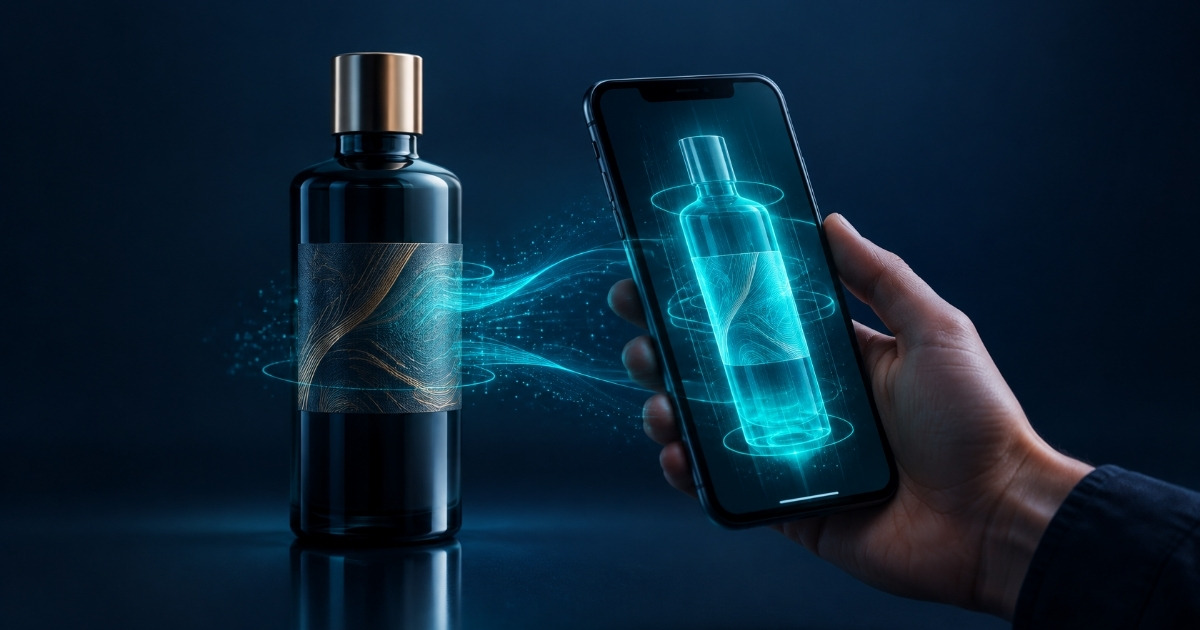
AR packaging — packaging that opens an augmented reality experience the moment a shopper scans it — has moved from a novelty stunt to a line item brand and marketing teams actually budget for. Global spending on connected packaging is rising alongside it: the market was valued at USD 361.4 million in 2025 and is projected to reach USD 595.8 million by 2033, a 6.8% CAGR from 2026 (Grand View Research, July 2026). This guide walks through what AR packaging is, what a real project costs and takes, what to ask a vendor before signing, and what results have actually been measured — not what a pitch deck claims.
What is AR packaging, exactly?
AR packaging is packaging that becomes interactive when scanned with a smartphone camera — usually via a QR code printed on a label or neck tag, or by the camera recognizing the label artwork itself — opening a browser-based augmented reality layer such as a 3D animation, product story, game or link to a loyalty program, without the shopper installing an app.
The AR layer sits visually on or around the physical product when viewed through the phone, which is what separates it from a plain QR code that just opens a webpage. The trigger (the QR code or the label) is only the doorway; the augmented reality content is what makes it "AR packaging" rather than a generic mobile landing page glued onto a product.
How much is this actually growing?
Two separate 2026 data points point the same direction. On market size, Grand View Research's July 2026 report puts the global AR packaging market at USD 361.4 million in 2025, forecasting growth to USD 595.8 million by 2033. On adoption, the Global Connected Packaging Survey — run by Appetite Creative and Koenig & Bauer AURAVEO across 712 executives in January–February 2026 — found 81.2% of organizations already using connected packaging, up from 72.6% a year earlier, with 83.3% planning connected-packaging campaigns in 2026 (up from 76.7%). Among brands that gamify their campaigns, 42.3% now include AR-based games specifically.
None of that is Indonesia-specific data — it's global survey and market-research figures — but it's a useful signal that this isn't a passing trend brands are testing and dropping; usage is climbing year over year.
What does an AR packaging project actually involve?
A real build has a handful of concrete decisions, not just "add AR":
Choosing the trigger. A QR code on a label or neck tag is the most flexible option — it works regardless of how different the artwork looks across SKUs or flavor variants. Recognizing the label artwork directly (image tracking) can feel more seamless to the shopper, but it requires the core design to stay visually consistent enough across variants for the tracking to work reliably.
Building the AR layer. This is 3D modeling and animation work, scoped to whatever the experience actually needs to do — product storytelling, a game, a tutorial or a simple "view in 3D" mode.
Device and browser testing. A WebAR experience has to be checked across the actual mix of Android and iOS devices and Chrome/Safari browser versions a brand's real customers use, not just one test phone.
Analytics. Scan counts, device split and geography are straightforward to track and worth asking for up front, since they're the only way to know whether the campaign actually worked.
On timeline and cost, InReality Solutions prices WebAR experiences from Rp 25 juta, typically delivered in 2-3 weeks for a single product, with multi-SKU catalogs or heavier gamification quoted after a short brief once scope is clear.
How do you choose an AR packaging vendor?
A few questions separate a vendor who's actually shipped this work from one who's pitching a concept:
Can they show a completed project with real numbers? Ask for scan counts or engagement data from a finished campaign, not a demo reel or a mockup.
Is it WebAR, or does it need a branded app? WebAR removes the single biggest source of drop-off — the app download — so a vendor steering a brand toward a dedicated app for a one-off packaging campaign is adding friction most shoppers won't push through.
Is analytics included, or an add-on? Scan and engagement data should be part of the base build, not a separate line item discovered after signing.
Do they handle multi-variant or multi-language packaging? If a product line has several flavors, sizes or language markets, confirm up front whether the same AR build covers all of them or whether each variant needs its own asset work.
Are they set up to support the launch locally? For a campaign running in Indonesia, a studio working in the same timezone with WhatsApp-reachable support tends to matter more during a live launch than it sounds on paper.
What results can AR packaging actually deliver?
Real numbers are harder to find than demo reels, which is exactly why they're worth asking for. One example from InReality's own work: for Sepoy & Co., a premium Indian tonic water brand, we built two interactive WebAR packaging experiences — a botanical-animation experience and a label-based storytelling experience — triggered by scanning a QR code on the bottle's neck tag. Together they generated 31,008 combined scans (17,680 on the botanical experience, 13,328 on the storytelling one), each one connecting the shopper to recipes, social media, WhatsApp, online shopping and the brand's loyalty program. Those are InReality's own measured numbers from a real, shipped project, not an industry-average estimate — though results on any single campaign will vary by category, SKU placement and how visible the scan prompt is on-shelf.
Is it worth it for a smaller Indonesian brand?
Often yes, if the approach is scoped to match the budget. Because a single-SKU WebAR pilot starts from Rp 25 juta and takes 2-3 weeks, a smaller brand doesn't need to commit to AR across an entire catalog to find out whether it works — testing it on one hero product, the SKU already carrying a launch or seasonal campaign, is a reasonable way to see real scan data before deciding whether to expand further. This is the same logic we've written about for WebAR adoption in furniture and electronics retail, where starting narrow and proving it on one product line comes before a full catalog rollout.
Sources
- Grand View Research — Augmented Reality Packaging Market Report (2026–2033), published July 2026
- eCommerceNews US — Connected Packaging Becomes Boardroom Imperative in 2026 (Global Connected Packaging Survey, Appetite Creative & Koenig & Bauer AURAVEO, Feb 2026)
- BrandXR — 2025 Augmented Reality in Retail & E-Commerce Research Report
Frequently Asked Questions
Does AR packaging require shoppers to download an app?
No, not if it's built as WebAR. A shopper scans a QR code or the label itself with their phone's camera, and the augmented reality experience opens directly in Chrome or Safari — no app store, no install. Some older AR packaging campaigns did require a branded app; that approach has mostly been replaced by WebAR because the app-download step loses the majority of shoppers before they ever see the experience.
How long does an AR packaging project take, and what does it cost?
At InReality Solutions, WebAR experiences — including packaging builds — start from Rp 25 juta and are typically delivered in 2-3 weeks, covering 3D modeling, the AR build and device testing. Larger projects covering many SKUs or custom gamification take longer and are quoted after a short brief, since scope is what actually drives the cost and timeline.
What's the real difference between a QR code and AR packaging?
A plain QR code just opens a link, usually a webpage. AR packaging uses the scan to trigger an augmented reality layer on top of the physical product itself — animation, a 3D model, a game or a story that appears to sit on or around the package when viewed through the camera. The QR code (or the label's own artwork) is only the trigger; the AR layer is what makes it packaging-specific rather than a generic mobile landing page.
Can one AR experience work across several product variants?
It depends on the trigger method. If the AR experience recognizes the printed label artwork directly, the core design needs to stay similar enough across variants for the tracking to work reliably — this held true across different beverage flavor variants in InReality's own Sepoy & Co. project. A QR-code trigger avoids that constraint entirely, since the code itself doesn't need to look the same as the rest of the label, making it the simpler choice for a catalog with many visually different SKUs.
Is AR packaging only worth it for large FMCG brands?
No. Because WebAR has a low entry point — a single-SKU pilot starts from Rp 25 juta and takes 2-3 weeks at InReality — a smaller brand can test the idea on one hero product or a limited run before deciding whether to roll it out across a full catalog, rather than committing to it sitewide from day one.
Does adding AR change the cost of printing the packaging itself?
Not meaningfully. Most AR packaging only needs a QR code or neck-tag added to existing artwork, or uses the artwork that's already there as the trigger. The cost sits almost entirely in building and testing the digital AR experience, not in the physical packaging or printing process.

Founder & Managing Director · LinkedIn
Ready to Build Your New Reality?
Tell us about your brand and goals — we'll show you what's possible.