AR for E-Commerce · 6 min read
Why Furniture and Electronics Sellers Need WebAR Before Indonesia's Harbolnas Season
Indonesia's retail growth is uneven ahead of Harbolnas. How WebAR 3D product viewers help furniture and electronics sellers convert without cutting price further.
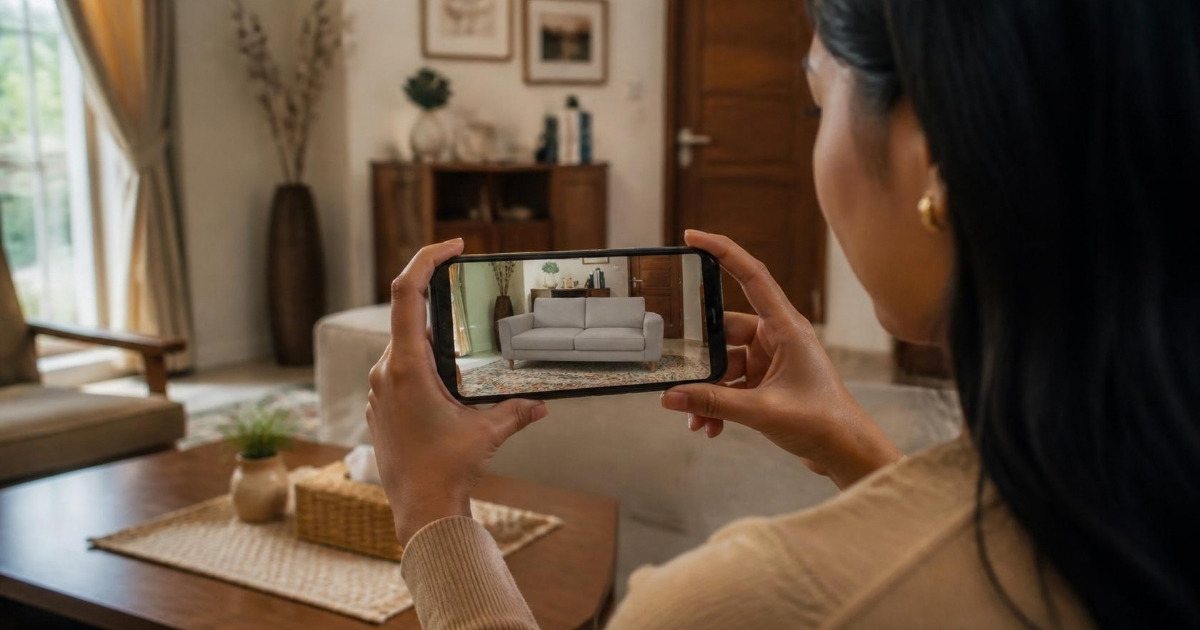
Indonesia's retail sales are growing again, but not evenly, and Harbolnas — the country's biggest online shopping season — is weeks away. For furniture, electronics and home-goods sellers, that combination means fighting harder for a smaller share of growth, in the middle of the most price-competitive weeks of the year. Browser-based augmented reality (WebAR) is one of the few tools that addresses the actual reason these categories under-convert online: buyers can't tell if a sofa fits the room or a TV looks right on the wall until it's too late to return easily.
Indonesia's retail recovery isn't reaching every category
Bank Indonesia's Retail Sales Survey for July 2026 showed the Real Sales Index up 1.1% year-on-year, a clear improvement after June's 3.0% contraction. But the recovery was uneven. Growth was "mainly driven by increased annual sales growth in the Food, Beverage and Tobacco Group and Other Goods Group," while Information and Communication Equipment — the category that includes phones, laptops and home electronics — contracted 1.7% year-on-year, and Culture and Recreation Goods fell 1.2%. Furniture isn't tracked as its own line in BI's survey, but it sits in the same discretionary, considered-purchase bracket as electronics: categories where buyers take longer to decide and are more sensitive to uncertainty about what they're actually getting.
That's the backdrop sellers in these categories are heading into Harbolnas with: overall retail demand recovering, but the specific categories they sell in lagging behind food, beverage and fast-moving goods.
Harbolnas is bigger every year, and more of a discount war
Indonesia's National Online Shopping Day (Harbolnas), anchored around 11.11 and 12.12, keeps growing. The 2024 edition recorded Rp31.2 trillion in transactions, up 21.4% year-on-year from Rp25.7 trillion in 2023, with 98 million shoppers spending an average of Rp318,000 each — even though it missed the government's Rp40 trillion target. Local products made up Rp16.1 trillion of that, up 31% year-on-year, which is a genuinely good sign for Indonesian brands selling into the event rather than just international ones.
The catch is how that growth is being won. Coverage of the Shopee–TikTok Shop rivalry heading into 2026 describes competition over promos, live shopping and affiliate campaigns as pushing sellers to be "more creative" just to keep up, with Shopee leaning on flash sales and subsidized shipping and TikTok Shop on live-stream shoppertainment. For a furniture or electronics seller, that means Harbolnas traffic is real, but it arrives already comparison-shopping and already expecting a discount. Matching the discount isn't a strategy — it's table stakes.
What actually stops a furniture or electronics sale
Price isn't the only reason a Harbolnas cart gets abandoned in these categories. A product photo can't tell a shopper whether a 2-meter sofa will overwhelm a small living room, whether a particular wood finish will look warm or orange under their own lighting, or whether a 55-inch TV will fit the console they already own. When that uncertainty isn't resolved before checkout, two things happen: some buyers don't check out at all, and others do, then return the item once it arrives and doesn't match what they pictured — which costs more than the lost sale, between reverse shipping, restocking and a buyer who's now had a bad experience with the brand.
Discounting harder doesn't touch either problem. It can even make the return problem worse, since a bigger discount pulls in more borderline buyers who were never fully sure the product would fit their space in the first place.
Letting shoppers see it before they buy
WebAR — augmented reality that runs directly in a phone's browser, with no app download — lets a shopper point their camera at their own living room, bedroom or wall and see a life-size, to-scale 3D model of the sofa, cabinet or TV sitting there before they buy. Industry research compiled by BrandXR, drawing on Shopify's own platform data and retailer case studies, found products with 3D/AR content converting at up to 94% higher rates than those without it, and 3D/AR product media cutting returns by as much as 40%. In a furniture-specific pilot, Macy's reported 25% fewer returns on items shown with AR or VR visualization. Those figures come from international retailers and platforms, not from the Indonesian market specifically, but the underlying mechanism — resolving size and fit doubt before checkout instead of after delivery — applies directly to the furniture and electronics problem described above.
The practical form this takes for most Indonesian sellers is a 3D product viewer embedded on the product page (so shoppers can rotate and inspect the item) paired with a "view in your space" AR mode triggered by a tap, with a QR code version for the same experience inside social-commerce posts, livestreams or Shopee/TikTok Shop listings that can't embed a full web page.
Getting it live before 11.11 and 12.12
The realistic window to do this before Harbolnas is narrow but workable if a seller starts now rather than during the promotion push. A single hero product — the sofa or TV model expected to carry the campaign — can go from product photos to a working WebAR viewer in one to two weeks once 3D modeling is underway; a small multi-product catalog typically needs three to six weeks. That timeline is one of the reasons to start the technical work in October rather than waiting until the week of 11.11, when the priority shifts to ad spend and promo copy instead.
This is the kind of work we do at InReality Solutions — browser-based AR for e-commerce, including 3D product viewers and "view in your space" placement that embed into existing WooCommerce, Shopify or custom storefronts without requiring an app. We've also written in more depth about turning a static product catalog into something interactive, which covers the same ground from the product-page side. If a Harbolnas catalog is already set and the only open question is which products are worth the AR investment first, that's a short conversation, not a long project.
Sources
- CNBC Indonesia — BI: Penjualan Eceran Juli 2026 Tumbuh 1,1%
- Jakarta Globe — National Online Shopping Day Records $1.9 Billion, Misses Target
- SEOUltra.id — Shopee vs TikTok Shop: Persaingan Makin Brutal di 2026
- BrandXR — 2025 Augmented Reality in Retail & E-Commerce Research Report
Frequently Asked Questions
Does a shopper need to download an app to use WebAR?
No. WebAR runs inside the phone's existing browser (Chrome or Safari). The shopper taps a link or scans a QR code, and the AR view opens immediately — no app store, no install.
Does AR actually reduce returns for furniture and electronics specifically?
Industry data from Shopify and retailer pilots compiled by BrandXR points to meaningful reductions — up to 40% fewer returns with 3D/AR product media generally, and 25% fewer returns in Macy's furniture-specific AR/VR pilot. Results vary by category and execution; these are the general industry figures, not an Indonesia-specific or InReality-specific result.
How long does it take to add AR product viewers before Harbolnas 2026?
A single product typically takes one to two weeks from photos to a live WebAR viewer. A multi-product catalog usually takes three to six weeks, which is why starting in October gives enough runway before 11.11 and 12.12.
Is this worth it for a seller with only a handful of SKUs?
Often yes, if those SKUs are the ones carrying the Harbolnas campaign. Starting with the one or two hero products expected to drive the most traffic is a reasonable way to test the approach before expanding to a full catalog.
Can WebAR work inside Shopee or TikTok Shop listings, not just a standalone website?
Those platforms don't support embedding a full web page, but a QR code or shareable link pointing to the WebAR experience can still be placed in the listing description, a livestream overlay or a social post, so the shopper reaches the same 3D/AR view from a tap or scan.

Founder & Managing Director · LinkedIn
Ready to Build Your New Reality?
Tell us about your brand and goals — we'll show you what's possible.