Case Study · 13 min read
How InReality Solutions Transformed MPL’s Five-Story Sporting Goods Store into an Interactive Virtual Shopping Experience
See how InReality Solutions transformed MPL’s five-story sporting goods store into an interactive virtual store connected directly to its Shopee marketplace.
Project Overview
| Client | MPL |
| Company | Maha Padda Lestari |
| Industry | Sporting Goods & Retail |
| Location | Medan, Indonesia |
| Solution | Interactive Virtual Store |
| Technology | Matterport |
| Project Completed | 2023 |
| Physical Store | Five Stories |
| Marketplace Integration | Shopee |
| Interactive Product Categories | 50+ Categories |
| Photography & Scanning | Completed by InReality Solutions |
| Development Period | Approximately 4 Days |
| Devices | Desktop, Mobile, Tablet & Compatible VR Devices |
| Primary Objectives | Brand Trust, Online Sales, Product Discovery & Customer Engagement |
| Reported Online Sales Impact | Approximately 20% Increase |
| Reported Average Basket Size Impact | Approximately 25% Increase |
| Scope | Virtual Store Strategy, 360° Capture, Development, Product Tagging, Marketplace Integration & Deployment |
On This Page (27)
- The Challenge: Bringing the Scale of a Physical Retail Business Online
- The Opportunity: Turning the Physical Store into a Digital Asset
- The Strategy: Combining Physical Retail Discovery with E-Commerce
- Creating MPL’s Five-Story Virtual Store
- More Than a Sporting Goods Store
- Connecting the Virtual Store Directly to Shopee
- Why We Integrated Product Categories Instead of Individual SKUs
- Creating Natural Product Discovery
- Building Trust with Online Customers
- Supporting Wholesale and Large-Volume Customers
- A Virtual Store Accessible Beyond Medan
- The Operational Challenge: Capturing a Busy Five-Story Retail Environment
- Preparing the Store for 360° Capture
- Working Around Limited Scanning Windows
- Maintaining Consistency Across a Dynamic Retail Environment
- Completing the Project in Approximately Four Days
- More Than 50 Interactive Product Category Connections
- Multi-Floor Navigation
- Accessible Across Desktop, Mobile, Tablet, and VR
- Used Across MPL’s Website and Social Media
- Ongoing Maintenance and Knowledge Transfer
- The Results
- 20% Increase in Online Sales
- 25% Increase in Average Basket Size
- Strengthening Customer Trust
- The Client Response
- More Than a Virtual Tour
The Challenge: Bringing the Scale of a Physical Retail Business Online
MPL operates an extensive five-story sporting goods store in Medan.
The physical store itself communicates something important about the company.
It demonstrates scale.
It demonstrates product variety.
It demonstrates that MPL is an established retailer capable of serving different types of customers and fulfilling substantial orders.
However, this physical credibility did not automatically translate to the online environment.
A customer discovering MPL through an online marketplace might see individual products and product listings.
But they would not necessarily understand the scale of the company behind those listings.
For conventional retail customers, this could affect brand familiarity and trust.
For wholesale customers and organizations considering larger orders, understanding the scale and capabilities of the supplier could be even more important.
MPL needed a stronger online presence that could communicate not only what they sold, but also who they were as a business.
The Opportunity: Turning the Physical Store into a Digital Asset
InReality Solutions approached MPL with a different idea.
Instead of treating the five-story physical store as something that could only be experienced by customers visiting Medan, why not make the store accessible online?
The physical store was already one of MPL’s strongest business assets.
It demonstrated:
- Product variety
- Business scale
- Retail presence
- Organizational capability
- Brand credibility
- Extensive inventory categories
The opportunity was to transform that physical asset into an online experience.
Customers anywhere could then virtually enter the store, move between departments, explore different categories, and understand the scale of MPL’s operations.
But we wanted to go further.
The objective was not simply to let customers look around.
We wanted them to shop.
The Strategy: Combining Physical Retail Discovery with E-Commerce
Conventional e-commerce is efficient.
A customer searches for a product, finds a listing, compares options, and makes a purchasing decision.
But conventional online shopping can also remove an important part of the physical retail experience: discovery.
When customers walk through a physical store, they do not only see the product they originally intended to purchase.
They see related products.
They discover other categories.
They remember items they need.
They notice products they may not have initially considered.
This natural discovery process can contribute to impulse purchases and larger basket sizes.
InReality Solutions wanted to bring this behavior into MPL’s online shopping experience.
The concept was simple:
Enter the Virtual Store → Explore the Physical Environment → Discover Products → Select a Category → Visit the Relevant Shopee Page → Purchase Online
The result combined elements of physical and digital retail into one connected customer journey.
Creating MPL’s Five-Story Virtual Store
InReality Solutions was responsible for capturing and developing the virtual experience of MPL’s physical store in Medan.
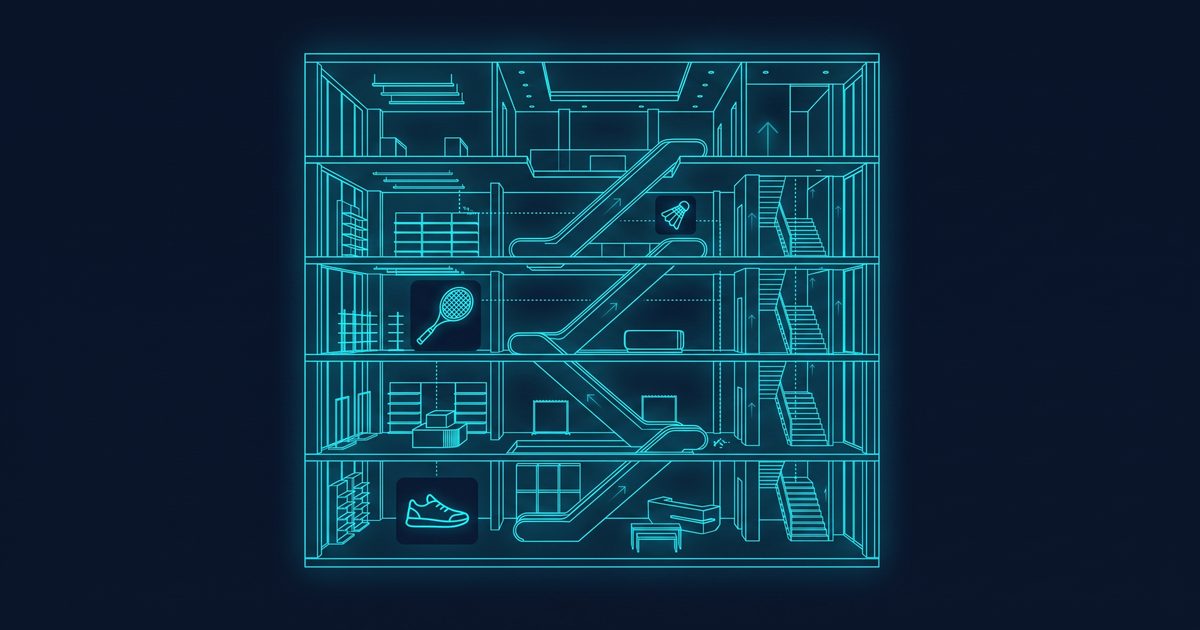
The store extended across five floors and occupied a substantial physical space.
Each floor contained different products and departments.
The objective was to create a virtual representation that allowed customers to move naturally through the store and understand how the different departments and product categories were organized.
Using Matterport technology, InReality Solutions digitally captured the physical environment and transformed it into an interactive virtual store.
Users could move between floors, walk through departments, inspect the retail environment, and discover different categories of sporting goods and other products.
More Than a Sporting Goods Store
One of the most important aspects of the MPL virtual experience was communicating the extensive variety of products available.
MPL’s physical store carried products across numerous categories, including:
- Sporting apparel
- Athletic footwear
- Badminton equipment
- Rackets
- Shuttlecocks
- Swimming equipment
- Sporting accessories
- Equipment for various sports
- Musical instruments
- Music-related products
- Other sporting and recreational goods
The store also included an extensive musical instrument section with a wide variety of instruments.
By allowing customers to virtually explore the real store, MPL could communicate the breadth of its product offering more effectively than through conventional online product listings alone.
Connecting the Virtual Store Directly to Shopee
The most important functionality of the MPL virtual store was the connection between the physical retail environment and MPL’s Shopee marketplace.
Throughout the virtual store, InReality Solutions incorporated interactive Mattertags.
These tags were connected to relevant product categories.
For example, a customer exploring the badminton department might see the rack displaying badminton rackets.
By clicking the relevant interactive hotspot, the customer could be taken directly to MPL’s Shopee marketplace page filtered for badminton rackets.
The same principle was applied throughout the virtual store.
More than 50 product categories were connected to relevant marketplace pages.
This created a direct connection between:
Seeing → Discovering → Exploring → Clicking → Shopping
Instead of asking customers to leave the virtual experience, open a marketplace, search for MPL, and then search again for the relevant product, the virtual store shortened the path between discovery and purchase.
Why We Integrated Product Categories Instead of Individual SKUs
One of the most important strategic decisions in the project was determining how products should be connected to the online marketplace.
One option would have been to connect every individual product inside the store to its corresponding online SKU.
However, this approach would not have been practical.
MPL carries a substantial number of products.
Inventory changes.
Individual products sell out.
New products arrive.
Displays change.
Products move between locations.
Maintaining individual links for every SKU would therefore create significant ongoing management requirements and could quickly result in outdated links.
InReality Solutions recommended a more scalable approach.
Instead of connecting individual SKUs, we connected product categories.
The physical location of departments and product categories remained considerably more consistent than individual products.
For example:
- Badminton rackets
- Shuttlecocks
- Swimming equipment
- Sporting apparel
- Footwear
- Musical instruments
When customers clicked a relevant hotspot, they were taken to the corresponding category on MPL’s Shopee marketplace.
This approach made the virtual store more scalable, easier to maintain, and better suited to the realities of a large retail operation.
Creating Natural Product Discovery
The virtual store gave customers a different way to shop online.
Rather than immediately searching for a specific item, users could browse.
They could walk through the physical environment.
They could move between departments.
They could discover categories they had not originally intended to explore.
Consider a customer initially interested in purchasing a badminton racket.
While virtually exploring the badminton section, that customer might also discover:
- Shuttlecocks
- Sports bags
- Shoes
- Clothing
- Accessories
- Other related equipment
This behavior more closely resembles shopping in a physical store than using a conventional online marketplace search bar.
That was an important part of the strategy.
The virtual store was designed to bring an element of retail discovery and impulse purchasing into the online customer journey.
Building Trust with Online Customers
The MPL virtual store also addressed another important business challenge.
Trust.
When customers purchase from an unfamiliar online retailer, particularly when considering large or wholesale orders, they may ask questions such as:
- Is this an established business?
- Does the company have a real physical presence?
- Do they carry an extensive product range?
- Can they handle large orders?
- Are they capable of serving customers outside their local area?
- Is the business credible?
The virtual store helped answer these questions visually.
Potential customers could enter the real MPL store online.
They could explore all five floors.
They could see the extensive product range.
They could understand the scale of the operation.
They could see that MPL was not simply an anonymous marketplace seller.
It was a substantial physical retailer with an extensive real-world presence.
Supporting Wholesale and Large-Volume Customers
MPL serves more than conventional retail customers.
The company also handles wholesale requirements and substantial orders from customers across Indonesia, including regional government requirements.
For these customers, supplier credibility and capability can be particularly important.
A large-volume buyer may need confidence that a supplier has:
- Sufficient business scale
- A broad product range
- Physical operations
- Experience handling different product categories
- The ability to support substantial requirements
Before the virtual store, customers outside Medan might have limited opportunities to understand MPL’s physical scale without visiting the location.
The virtual experience changed this.
Customers could remotely inspect the store and gain a clearer understanding of MPL’s business presence.
This helped the company build confidence with potential customers regardless of their physical location.
A Virtual Store Accessible Beyond Medan
MPL’s physical store is located in Medan.
However, its customers are not limited to Medan.
The company serves customers and organizations across different parts of Indonesia.
The virtual store helped remove geographical limitations from the physical retail experience.
Someone outside Medan could still:
- Visit the store virtually
- Explore the different floors
- Understand the product range
- Navigate between departments
- Discover product categories
- Connect directly to MPL’s Shopee marketplace
The store remained physical.
But the experience became nationally accessible.
The Operational Challenge: Capturing a Busy Five-Story Retail Environment
Creating the MPL virtual store presented a significant operational challenge.
This was not an empty showroom.
It was an active retail business.
The store contained:
- Customers
- Employees
- Extensive product displays
- Merchandise
- Changing inventory
- Numerous departments
- Multiple floors
- Constant activity
The InReality Solutions team needed to digitally capture the complete environment while minimizing disruption to the store’s operations.
Preparing the Store for 360° Capture
Preparation was critical.
Before scanning, the environment needed to be organized to ensure the final virtual store presented MPL professionally.
This involved:
- Organizing products
- Removing unnecessary clutter
- Preparing displays
- Coordinating with employees
- Managing customers and people within the environment
- Ensuring different areas were ready for capture
Much of this preparation was conducted before the main scanning process.
This allowed the InReality Solutions team to work efficiently during the limited periods available outside normal operating hours.
Working Around Limited Scanning Windows
Because MPL was an active store, our team could not simply close the entire business for an extended period.
The available scanning periods were limited.
Each floor needed to be captured efficiently within the available time.
This required careful planning.
Our team needed to understand:
- Which areas would be captured
- In what order they would be captured
- How the scanning path would progress
- How different sections would connect
- How consistency would be maintained between scanning sessions
The objective was to capture a large, complex retail environment without disrupting normal business operations.
Maintaining Consistency Across a Dynamic Retail Environment
Another challenge was maintaining visual and spatial consistency.
Retail stores are dynamic environments.
Products move.
Customers move.
Employees move.
Displays can change.
Objects may be relocated between one scanning session and another.
Because the five-story store could not be captured instantaneously, the InReality Solutions team needed to carefully manage these changes.
If objects or displays moved significantly between connected scanning locations, the final virtual environment could become visually inconsistent.
Our team therefore needed to work quickly, coordinate carefully, and maintain as much consistency as possible throughout the capture process.
Completing the Project in Approximately Four Days
Despite the scale of the five-story store and the operational challenges involved, the main project was completed in approximately four days.
Within this period, InReality Solutions handled:
- Store preparation
- Capture planning
- Matterport scanning
- 360° photography
- Multi-floor integration
- Navigation
- Interactive Mattertags
- Product category mapping
- Shopee marketplace integration
- Testing
- Deployment
The ability to complete the project quickly minimized disruption to MPL’s business while allowing the virtual store to launch efficiently.
More Than 50 Interactive Product Category Connections
One of the most extensive parts of the project involved mapping the physical retail environment to MPL’s online marketplace.
More than 50 product categories were connected to corresponding Shopee marketplace pages.
Each relevant area needed to be:
- Identified
- Categorized
- Connected to the correct marketplace destination
- Tagged inside the virtual environment
- Tested
The result was a retail experience where physical exploration and digital purchasing worked together.
Multi-Floor Navigation
Because the MPL store extended across five stories, navigation was particularly important.
Users needed to understand:
- Where they were
- Which floor they were exploring
- What departments were available
- How to move between different areas
The experience was structured to allow users to explore the different floors and understand the overall store layout.
This prevented the size of the store from becoming overwhelming and helped users navigate more effectively.
Accessible Across Desktop, Mobile, Tablet, and VR
The Matterport-based virtual store could be accessed across different devices.
These included:
- Desktop computers
- Laptops
- Smartphones
- Tablets
- Compatible VR devices
This allowed customers to explore the store using whichever device was most convenient for them.
Used Across MPL’s Website and Social Media
Following completion, the virtual store became part of MPL’s online presence.
The experience was used across:
- MPL’s website
- Social media channels
- Online marketing activities
This helped MPL use its physical retail environment as an ongoing digital marketing and sales asset.
Ongoing Maintenance and Knowledge Transfer
Following the initial launch, InReality Solutions continued maintaining the virtual store for several years.
Over time, MPL developed the capability to manage the experience internally.
Responsibility for the virtual store was eventually transitioned to the MPL team.
This allowed the platform to continue supporting the company’s digital presence beyond the initial project period.
The Results
The success of the MPL virtual store was not simply determined by whether users could navigate the experience.
The objective was to create something that positively contributed to the business.
According to results reported by MPL, the virtual store contributed to an approximately:
20% Increase in Online Sales
By connecting physical retail discovery directly to MPL’s online marketplace, the virtual store helped create an additional pathway toward online purchasing.
Customers could discover products while exploring the physical store and move directly to the relevant Shopee category to continue their purchasing journey.
25% Increase in Average Basket Size
MPL also reported an approximately 25% increase in average basket size associated with the virtual store experience.
One of the key reasons was increased product discovery.
Customers entering the virtual store for one product category could encounter other relevant items while exploring.
This recreated an important characteristic of physical retail shopping.
Customers remembered additional products.
They discovered related categories.
They saw items they had not initially considered purchasing.
The result was a larger average purchase value.
Strengthening Customer Trust
Beyond direct sales performance, the virtual store helped MPL communicate the scale and credibility of its business.
New customers could see:
- A real five-story physical store
- Extensive product categories
- Substantial retail operations
- A broad selection of goods
- The scale of the company’s physical presence
This was particularly valuable for customers considering large-volume purchases and customers located outside Medan.
Instead of simply telling customers that MPL was capable of handling substantial orders, the virtual store allowed them to see the scale of the business for themselves.
The Client Response
For InReality Solutions, the greatest measure of success was that the completed platform became genuinely useful to MPL’s business.
The virtual store was not created simply as a technology demonstration.
It was actively used to:
- Build customer trust
- Strengthen MPL’s online presence
- Communicate business scale
- Support product discovery
- Connect customers to Shopee
- Increase online purchasing opportunities
- Support customers outside Medan
- Strengthen confidence among larger buyers
The positive response from MPL and the continued use of the platform demonstrated that the solution addressed a genuine business requirement.
More Than a Virtual Tour
The MPL project demonstrates how immersive technology can be used beyond conventional virtual tours.
The project began with a five-story physical sporting goods store.
InReality Solutions transformed it into:
- An interactive virtual store
- A digital brand-building platform
- A product discovery experience
- A trust-building tool
- A connection between physical and online retail
- An additional pathway to e-commerce
- A platform accessible to customers across Indonesia
The experience connected more than 50 product categories directly to MPL’s Shopee marketplace.
According to results reported by the client, it contributed to an approximately 20% increase in online sales and a 25% increase in average basket size.
The result demonstrated a simple but powerful idea: a physical store does not have to stop creating value when customers leave the building.
With the right immersive strategy, the physical retail environment itself can become a scalable digital sales and marketing asset.
Frequently Asked Questions
What did InReality Solutions create for MPL?
InReality Solutions transformed MPL’s five-story physical sporting goods store into an interactive virtual shopping experience using Matterport technology. Customers could virtually explore the store, discover different product categories, and connect directly to relevant category pages on MPL’s Shopee marketplace.
What is MPL?
MPL is a sporting goods retailer operated by Maha Padda Lestari. The company has physical stores in Medan and Jakarta and serves retail, wholesale, and large-volume customers across Indonesia.
Where is the MPL virtual store located?
The physical store captured for the virtual experience is located in Medan, Indonesia.
How large is the MPL store?
The MPL store featured in the project extends across five stories and contains an extensive range of sporting goods, apparel, footwear, swimming equipment, badminton equipment, musical instruments, and other products.
What technology was used to create the MPL virtual store?
The virtual store was created using Matterport technology.
How does the MPL virtual shopping experience work?
Customers explore the real MPL store virtually. When they discover a relevant product category, they can click an interactive hotspot that takes them directly to the corresponding product category on MPL’s Shopee marketplace.
How many product categories were connected to Shopee?
More than 50 product categories were connected to relevant marketplace pages.
Why were products linked by category instead of individual SKU?
MPL carries a substantial and frequently changing inventory. Connecting every individual SKU would require significant ongoing maintenance as products sold out, new inventory arrived, and displays changed. Category-based integration provided a more scalable and sustainable solution.
Can customers purchase products directly through the virtual store?
The virtual store connects customers directly to relevant product categories on MPL’s Shopee marketplace, where they can browse available products and complete their purchases.
How did the virtual store help build customer trust?
The virtual store allowed customers to see MPL’s real five-story physical retail environment. This helped demonstrate the scale, product range, and physical presence of the company, particularly to new customers and organizations considering larger orders.
Did the virtual store support wholesale customers?
The experience helped potential wholesale and large-volume customers better understand MPL’s physical scale and product range without needing to visit the Medan store personally.
How long did the project take to complete?
The main project was completed in approximately four days.
Who handled the Matterport scanning and virtual store development?
InReality Solutions handled the capture planning, store preparation, Matterport scanning, 360° photography, navigation, interactive product tagging, marketplace integration, testing, and deployment.
Was the MPL virtual store available on mobile devices?
Yes. The Matterport-based experience could be accessed through desktop computers, smartphones, tablets, and compatible VR devices.
Where was the virtual store used?
MPL used the experience on its website, social media channels, and other online marketing activities.
Did InReality Solutions maintain the virtual store?
Yes. InReality Solutions maintained the virtual store for several years following its launch before management was eventually transitioned to MPL’s internal team.
What results did the MPL virtual store achieve?
According to results reported by MPL, the virtual store contributed to an approximately 20% increase in online sales and a 25% increase in average basket size.
Want Results Like MPL?
Tell us about your project — we'll show you what's possible.