Virtual Tours · 8 min read
Museum Virtual Tour Pricing in Indonesia: A Practical Budgeting Guide
What a museum virtual tour costs in Indonesia, why it is priced per panorama, and what separates a tour that gets used from one that just exists.
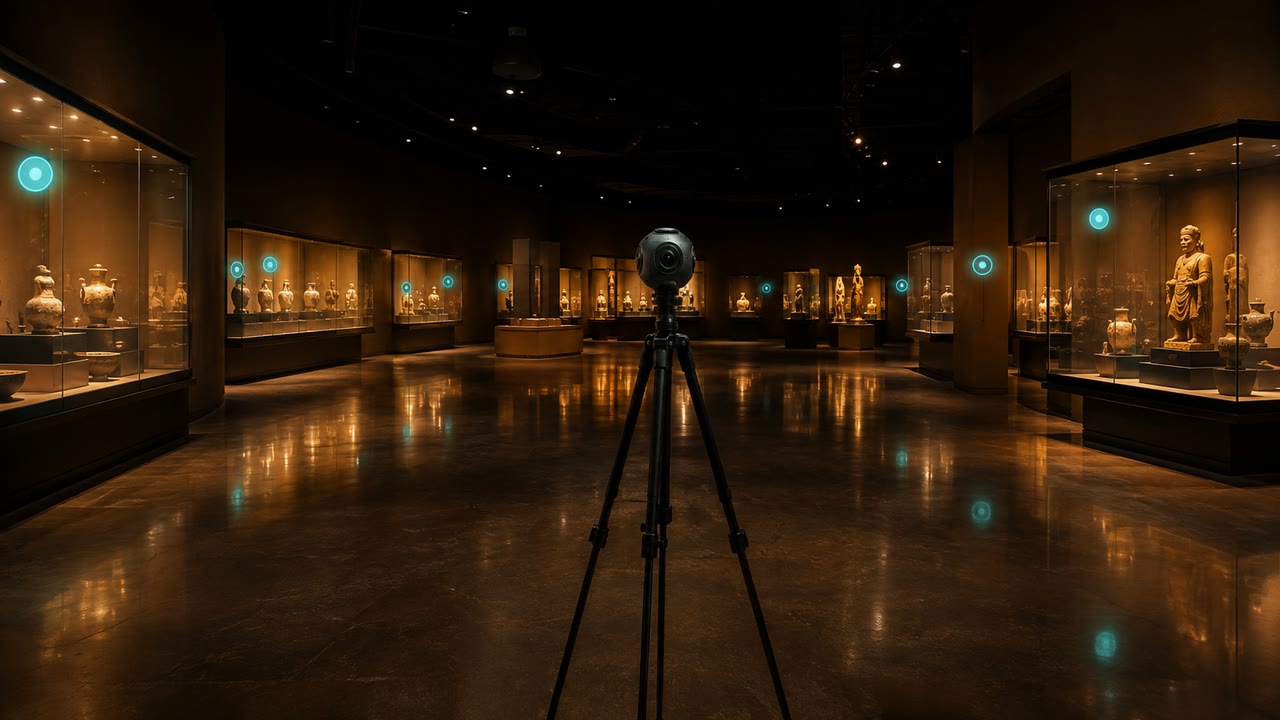
Most museums asking about virtual tour pricing have already been quoted wildly different numbers — one vendor at a few hundred thousand rupiah per room, another at ten times that. Both are describing something they call a virtual tour. Only one of them is describing a tool the museum will still be using in three years.
This guide explains how museum virtual tours are actually priced in Indonesia, what sits inside a professional figure, and — more usefully — how to tell from a quotation which kind of tour you are being sold.
The short answer
For a professionally built museum virtual tour, expect roughly Rp 2,000,000 to Rp 3,000,000 per panorama. That band assumes the tour includes properly designed hotspots, a custom interface skin matched to the museum's identity, an app-like browsing experience, and a build planned and executed by developers who have done this before.
Quotations well below that band exist in large numbers. They are usually buying you photography and a stitching tool, not a visitor experience — which is a real distinction, and the rest of this guide is about where it shows up.
Why virtual tours are priced per panorama
Because the panorama is the unit of work. Each one is a separate setup: tripod positioned, exposures bracketed, the shot cleared of staff and visitors, the operator removed from the nadir, the image stitched, colour-matched to its neighbours, then linked and hotspotted inside the tour.
Floor area is a poor proxy — one large hall may need three panoramas while a dense gallery of display cases needs twelve. Day rates are worse, because they price the photographer's time rather than the finished asset, and a museum is buying the asset. Per-panorama pricing is the only unit that scales honestly with the work, which is why serious vendors quote in it.
How many panoramas does a museum need?
Panorama count is a scoping decision, not a technical one — it follows from how you want a visitor to move through the space. As a starting point for estimating:
| Museum scale | Typical panorama count | What drives it |
|---|---|---|
| Single gallery or temporary exhibition | 8–15 | One per viewpoint plus entry, transitions and a wide establishing shot |
| Small museum, 2–4 rooms | 20–35 | Room coverage, corridors between rooms, and close positions at key artefacts |
| Mid-size museum, one or two floors | 40–80 | Stairwells and landings, façade and grounds, denser coverage in dense galleries |
| Large or multi-building institution | 100+ | Multiple buildings, outdoor circulation, and a navigable map layer to tie them together |
Multiply your realistic panorama count by the band above and you have a working budget to take into a planning meeting. Do that before you request quotations — it changes the conversation from "how much is a virtual tour" to "here is our scope, price it", which is a much harder thing for a vendor to answer vaguely.
Resist the instinct to maximise the count. A tour with 60 well-chosen positions is easier to navigate, and more used, than one with 120 that leaves the visitor lost. Coverage is not the goal; comprehension is.
What the professional band includes — and what it does not
| Normally inside a per-panorama rate | Normally quoted separately |
|---|---|
| On-site capture, bracketed exposures, operator removal, stitching and colour matching | Professional voice-over or narration recording |
| Navigation hotspots and the movement logic between positions | Translation of interpretive text into additional languages |
| Information hotspots carrying the museum's own artefact text and images | New photography or 3D scanning of individual artefacts |
| Custom interface skin in the museum's identity | Bespoke feature development beyond the standard tour platform |
| Floorplan or map navigation where the layout needs one | Annual hosting after the included period, and later content updates |
| Mobile, tablet and desktop behaviour, plus embedding on the museum's site | VR headset builds, if the museum wants an on-site headset experience |
Ask every vendor to mark which column each item falls in. The gap between a cheap quotation and a professional one is very often not the rate — it is that half of the left-hand column has quietly moved to the right, or vanished.
Why the cheapest tour usually costs the most
A cheap tour is rarely a smaller version of a good one. It is a different product. There are many operators charging significantly less, and the tours they produce tend to share a signature: the panoramas are fine, and nothing else has been thought about. You can move between rooms and that is the entire proposition.
What that produces is a tour that exists for the sake of existing — something the museum can point to in a report, rather than something a teacher, a researcher, or a visitor planning a trip actually opens. It gets built, launched, linked once from the homepage, and quietly stops being mentioned.
The cost is not the wasted fee. It is that the museum now believes it has a virtual tour, and the case for doing it properly becomes much harder to make for several years.
What "well planned" actually means for a museum
The difference between the two kinds of tour is almost entirely decisions made before anyone picks up a camera. Beautiful panoramas are the floor, not the ceiling. A tour built by people who have done it before is thinking about:
- Visitor psychology. Where does someone arrive, and what do they see first? A tour that opens facing a blank wall or an empty corridor loses people in the first five seconds. The opening frame is a design decision, not whichever panorama happens to be numbered one.
- The journey through the space. Physical museums are curated in a sequence — an argument that unfolds room by room. A tour that lets visitors teleport arbitrarily can destroy that sequence, or, done well, can preserve it while still allowing a researcher to jump straight to the object they came for.
- The information a visitor will want at each point. Standing in front of a case, what does someone actually ask? Provenance, date, the story behind the acquisition, why it matters. Anticipating those questions and putting the answer one tap away is what turns a panorama into an exhibit.
- Access to deeper material. Museums hold far more context than fits on a wall label — catalogue entries, archival photographs, conservation notes, video. A well-built tour gives the interested visitor a route into that depth without burying the casual one in it.
- Who else is using it. A teacher planning a class, a curator presenting to a funder, a prospective visitor deciding whether to travel, a researcher overseas who will never visit. These are different journeys through the same asset, and the good tours are built knowing all four exist.
None of this is visible in a quotation. All of it is visible in the tours a vendor has already built, which is why the portfolio matters more than the proposal.
What moves the price
- Depth of interpretive content. A tour with three information hotspots per room is a different build from one with twenty, each carrying text, images and links.
- Access conditions. Galleries that must be shot after closing, or in short windows between exhibitions, extend the schedule and the cost.
- Lighting. Conservation lighting is deliberately dim and often mixed in colour temperature. Producing clean, low-noise panoramas under it takes longer than shooting a naturally lit building.
- Languages. Bahasa Indonesia and English is the common pairing; each additional language multiplies the interpretive content, not the photography.
- Integration. Embedding in the museum's website is standard. Feeding a collection management system, or pulling live object records, is development work.
- Update cycle. Permanent galleries are shot once. If temporary exhibitions are to be added two or three times a year, agree that rate at the start rather than as a series of small separate jobs.
Questions to ask before you sign
These separate vendors quickly, and none of them are technical.
- May I see three museum or heritage tours you have built, and speak to one of those clients?
- Who writes and structures the interpretive content — us, or you? What do you need from our curatorial team, and when?
- What is the opening view, and why that one?
- Who hosts the tour, for how long, and what does year two cost?
- If a gallery is re-hung next year, what does it cost to re-shoot just that gallery?
- Do we own the panoramas themselves, or only the assembled tour?
The last two are the ones most often left undefined, and the ones that hurt later. Get both in writing.
Production realities specific to museums
Museums are among the more demanding environments to shoot, and a vendor who has not worked in one tends to discover this on the day.
Flash is usually prohibited outright, which means long bracketed exposures and a tripod that cannot be bumped. Conservation lighting is dim and mixes colour temperatures within a single frame. Cases are glass, so reflections — including of the camera — have to be managed at capture rather than fixed afterwards. Shooting almost always happens outside opening hours, which compresses the schedule. And curatorial approval of every piece of interpretive text is a real stage with a real duration, not a formality to be squeezed into the final week.
A schedule that ignores these is a schedule that slips. For a mid-size museum, plan on capture inside a week, with the full build and curatorial review cycle running four to eight weeks depending on how much interpretive content is involved.
Getting a scoped quotation
InReality Solutions is a Google Street View Trusted and Matterport partner, and has delivered virtual tours for museums, galleries, developers and hospitality across Indonesia. If you want a figure for your building rather than a band, the fastest route is a walkthrough — we scope the panorama count with you and quote against it.
Read our full guide to producing a museum virtual tour for the workflow behind this, see our 360° virtual tour services, or talk to our team in Jakarta.
Frequently Asked Questions
How much does a museum virtual tour cost in Indonesia?
For a professionally produced tour, budget roughly Rp 2,000,000 to Rp 3,000,000 per panorama. That band assumes properly designed navigation and information hotspots, a custom interface skin in the museum's identity, an app-like browsing experience across mobile and desktop, and a build planned and executed by experienced developers. A small museum of two to four rooms typically needs 20 to 35 panoramas; a mid-size institution 40 to 80. Multiplying your realistic panorama count by that band gives a working budget before you request quotations.
Why are some virtual tour quotations so much cheaper?
Because they are usually for a different product. The low end of the market delivers panoramas linked together and little else — no interpretive hotspots, no designed opening view, no custom interface, no thought given to how a visitor moves through the space. The photography may be perfectly competent. What is missing is the design work that turns a set of images into something a teacher, researcher or prospective visitor actually uses. The result tends to be a tour that launches, gets linked once, and is then quietly forgotten.
Is a virtual tour priced per square metre or per panorama?
Per panorama, in any serious quotation. Floor area is a poor proxy for the work involved — a single large hall may need three panoramas while a dense gallery of display cases needs twelve. Day rates are worse, because they price the photographer's time rather than the finished asset. Each panorama is a discrete unit of work: setup, bracketed capture, operator removal, stitching, colour matching, and hotspot linking. Pricing per panorama is the only unit that scales honestly with that.
What should be included in a museum virtual tour quotation?
At minimum: on-site capture and post-production, navigation hotspots, information hotspots carrying your artefact text, a custom interface skin, floorplan navigation where the layout needs one, correct behaviour on mobile and desktop, and embedding on your website. Commonly quoted separately: voice-over recording, translation into additional languages, 3D scanning of individual artefacts, hosting beyond the included period, and VR headset builds. Ask every vendor to state explicitly which side of that line each item falls on — that gap, rather than the headline rate, is usually what separates two quotations.
How long does a museum virtual tour take to produce?
For a mid-size museum, capture usually fits inside a week, with the full build running four to eight weeks afterwards. The variable is rarely the photography — it is the interpretive content and its curatorial approval cycle, which is a real stage with a real duration. Museum shoots also happen outside opening hours and cannot use flash, so schedules are tighter than they look. Agreeing the content workflow and who signs off on text at the start is what keeps the timeline honest.

Founder & Managing Director · LinkedIn
Ready to Build Your New Reality?
Tell us about your brand and goals — we'll show you what's possible.