- Home
- Blog
- VR Training for Large-Scale F&B Operations: Turning SOPs Into Measurable, Repeatable Training
Virtual Reality · 11 min read
VR Training for Large-Scale F&B Operations: Turning SOPs Into Measurable, Repeatable Training
How a multi-brand restaurant group cut training cost and tripled retention by simulating its real restaurants in VR instead of rebuilding them in 3D.
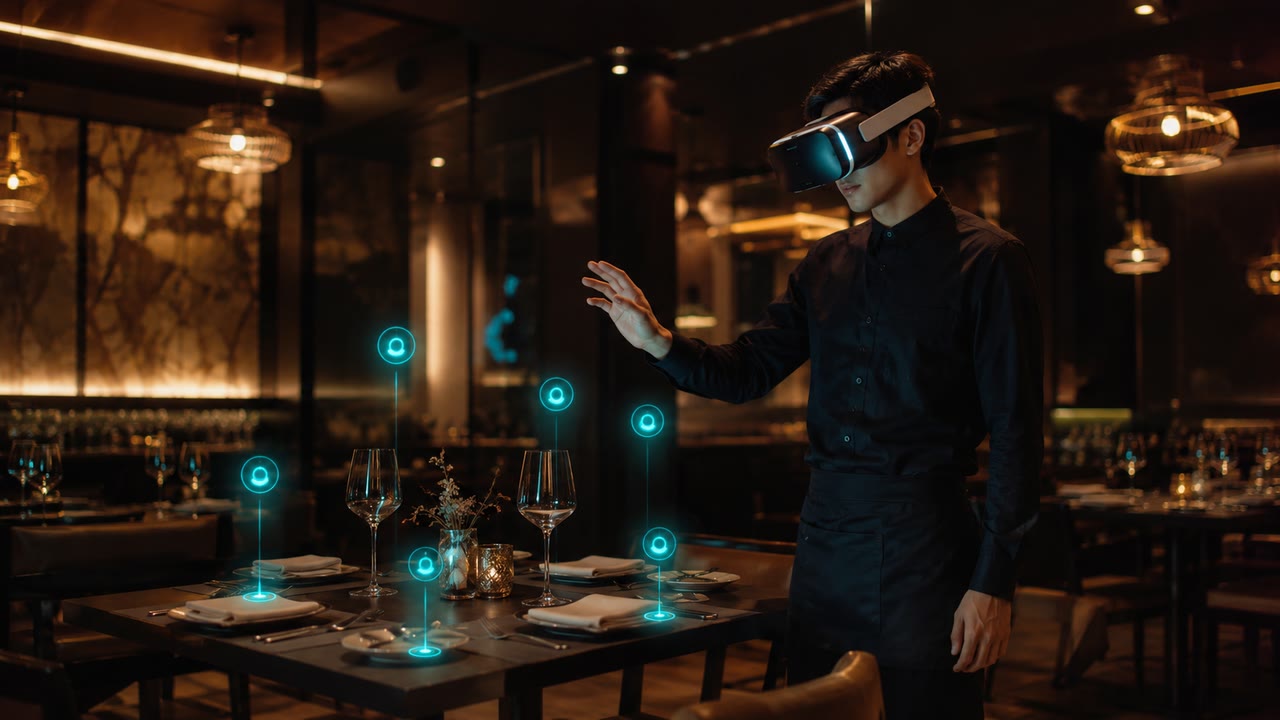
A restaurant group operating several brands across hundreds of locations does not have one training problem. It has one for every brand it owns.
Each brand carries its own standard operating procedures, its own service standards, its own rules about how a table is laid and how a guest is greeted. Multiply that by hundreds of outlets, by continuous hiring, by staff who need periodic retraining, and training stops being a human resources function and becomes an operational and financial problem at national scale.
This is an account of how one such group solved it — and why the answer turned out to be less technology rather than more.
The problem: more SOPs than anyone can hold
The group's training was built on theory, and theory was not sticking. Onboarding relied on classroom instruction, documentation, manuals and materials that new employees were expected to read and absorb before their first shift.
When the group measured what survived that process, it found that only around 20% of the information was typically retained. Employees held on to what was logical and structural — the shape of a shift, the order of service — and lost the small, specific details that make a brand feel consistent to a guest.
The example the client used to illustrate this is deliberately mundane. How many brown sugar packets and how many white sugar packets belong on a table? It is a trivial thing to state and a trivial thing to forget. When employees were tested on it, only around one in ten remembered it correctly.
The instinct is to read that as an employee problem. It is not. Nobody reliably retains dozens of granular procedural details from a document they read once, and no amount of restating the manual changes that. The limitation belonged to the training method, not the people being trained.
Practical training worked — and that was the expensive part
The group already knew what fixed retention. It had run the experiment. When employees practised the same procedures through role-play and hands-on scenarios rather than reading about them, retention rose by roughly three times compared with theory alone.
That finding created the real dilemma. Practical training works because it is physical, supervised and repeated — and every one of those properties is a cost. Running it properly across hundreds of restaurants means trainers travelling, outlets releasing staff, sessions scheduled around service, and the whole exercise repeated for every intake and every refresher cycle.
So the group was not looking for a better training method. It had one. It was looking for a way to reproduce the effect of practical training without reproducing its cost every single time.
The first attempt at VR, and what it exposed
Before approaching InReality Solutions, the group had already tried VR, working with MILEA Labs on an approach built around animated, computer-generated environments and scenarios.
Two problems emerged, and both were structural rather than cosmetic.
The first was time. Building scenes and modules was slow; in some cases simply constructing the restaurant environment took around a month. For a group that needed coverage across multiple brands and a large estate of locations, a month per environment is not a schedule — it is a ceiling.
The second was accuracy, and it mattered more. Because the environments were assembled from the platform's available digital asset library rather than modelled on the group's actual restaurants, what trainees practised in was a generic approximation. A server learned to lay a table in a room that resembled no restaurant they would ever be posted to.
That is a quiet but serious flaw in a training tool. The entire argument for practical training is that rehearsal in the real setting transfers to performance in the real setting. An abstract environment gives back some of that advantage the moment it stops matching reality.
The insight: the most realistic environment already existed
The group arrived assuming the fix was a more sophisticated VR build. The opposite was true. The route to a better and far cheaper experience was to stop reconstructing restaurants digitally and start using the real ones.
Rather than rebuilding each outlet as a 3D environment, InReality Solutions proposed capturing the group's actual restaurants and simulating real scenarios inside them. The training environment already existed, fully detailed and perfectly accurate, in every location the group operated. It only needed to be captured.
The commercial consequence was immediate: the approach worked out approximately three times cheaper than producing equivalent animated scenes, and it removed the month-per-environment bottleneck that had capped the previous attempt.
It is worth being precise about what kind of decision this was. It was not a technology preference. It was a training-design decision, and it rested on understanding several things at once:
- The group's actual operational problem — scale and repetition, not production values
- How people retain procedural knowledge, and why practical rehearsal outperforms reading
- What VR genuinely does well, and where it adds cost without adding learning
- Which training situations truly require interactive 3D environments
- Which situations are served just as well, or better, by real-world imagery
- How to design something that scales across many brands and many locations without being rebuilt each time
Getting that judgement right is the whole of this project. Everything after it is execution.
What the training actually looks like
The result is an immersive simulation of the employee's real workplace, not an abstraction of it. Trainees move through environments captured from the group's own restaurants — the actual layout, the actual menus, the tables, the equipment, the service floor as it exists.
The difference this makes is not aesthetic. An employee is not learning a procedure in a training room and then translating it to the restaurant later. They are rehearsing in a representation of the place they will actually work, which is the condition under which practical training earns its retention advantage in the first place.
The system was built as modules, so each brand's SOPs, standards and service sequences could be delivered as its own training path within a single platform.
Scenarios from both sides of the table
Some scenarios put the trainee in the guest's position, others in the server's. Seeing the experience from the customer's point of view teaches what a guest notices and expects. Switching to the employee's perspective then requires the trainee to act on it.
| Trained through scenarios | What the trainee practises |
|---|---|
| Greeting and first contact | Approaching a guest correctly and to the brand's standard |
| Guest interaction | Responding appropriately across different situations and guest types |
| Table preparation and checking | Setting and verifying a table against the brand's specification |
| Navigating the restaurant | Moving through the real floor plan of the outlet they will work in |
| Service procedures | Following the sequence of service that brand requires |
| Brand-specific SOPs | The rules that differ between the group's brands, taught separately |
Training the eye, not just the hands
Not every training objective requires the employee to do something. Some require them to notice something. This is where the approach earns its keep most obviously.
The experience can present a 360° view of a table that has been set incorrectly, and ask the trainee to identify what is wrong with it. Are the right number and type of sugar packets present? Does the setting match the standard?
That is the same detail that survived in only one employee in ten when it was taught from a document. Delivered this way it stops being a fact to memorise and becomes a judgement to exercise — the employee has to look at a real table and decide whether it passes. Attention to detail is trained by requiring attention, not by describing it.
Quizzes that test recall in context
Knowledge checks were built in, drawing on material employees had already covered in theory training. The point was not to teach the information a second time. It was to find out whether an employee could retrieve and apply it while standing in a realistic environment — which is where it actually has to be available.
Scoring, and connecting it to the LMS
Employees are scored on what they do. Correct actions and answers earn points; incorrect ones lose them where a deduction is warranted. At the end of a session, results feed into the group's learning management system.
This is the step that changes what VR is for. Without it, an immersive session is an experience that leaves no record. With it, training becomes measurable at the level of the individual employee and feeds the group's wider development and evaluation process — a manager can see who has demonstrated competence in which procedures, at which brand, and act on it.
Deciding what needs 3D and what does not
The reusable lesson from this project is a triage question, not a technology. Before building anything immersive, it is worth asking which of these a given training objective actually is:
| Training objective | What it genuinely needs |
|---|---|
| Recognising whether a real environment meets a standard | Real-world capture. Accuracy is the entire point; a modelled approximation weakens it. |
| Learning the layout and flow of a specific location | Real-world capture of that location. A generic space teaches nothing transferable. |
| Rehearsing a service sequence or guest interaction | Scenario design and branching, which sit on top of captured environments perfectly well. |
| Testing recall of procedural detail | Assessment design and scoring — the environment only needs to be believable. |
| Manipulating equipment with complex physical handling | Interactive 3D, where the interaction itself is the skill being learned. |
| Rehearsing something that cannot be safely or legally staged | Interactive 3D, since the real scenario cannot be captured at all. |
Most F&B training objectives fall in the upper half of that table. The previous approach had treated all of them as though they belonged in the lower half, and paid for the difference in both money and months.
The results
The group reportedly achieved return on investment across its restaurant network within the first year. The average payback period was approximately ten months, and almost all implementations reached payback in under a year.
The outcome that matters is the combination rather than any single figure:
- Training costs fell significantly, and the build itself was approximately three times cheaper than producing equivalent animated environments.
- Retention improved by roughly three times against theory-based training, matching what the group had already measured from physical role-play.
- Training became standardised and scalable across brands and locations, rather than being reproduced outlet by outlet.
- Employees demonstrated substantially better understanding of procedures, including the granular details that documentation had failed to transfer.
- Practice and assessment no longer required the same volume of repeated physical training, which is where the recurring cost had been concentrated.
- Results became measurable and connected to the LMS, making training auditable rather than assumed.
- Realistic scenarios could be created without building every environment from scratch in 3D, removing the month-per-location constraint.
What VR did not replace
This did not abolish conventional training, and it was never intended to. Theory still has a role: policy, food safety, brand context and the reasoning behind a procedure are all reasonably delivered as instruction. Live supervision still matters for the parts of hospitality that are genuinely interpersonal and unscripted.
What VR replaced was a specific and expensive segment: the repetitive, physically-staged practical training that had to be reproduced continuously across hundreds of locations to keep standards consistent. That portion was costing the most and varying the most between outlets, which is precisely why it was the right portion to move.
The broader lesson
The innovation here was not using VR for training. It was understanding how to use it.
The group arrived believing that an effective solution required fully animated environments, first-person 3D interaction and extensive digital reconstruction — because that is what a VR training system is generally assumed to be. That assumption was the expensive part. It had already produced a slow build and environments that did not match the restaurants they were meant to represent.
Combining real-world 360° capture with carefully designed scenarios, observation exercises, in-context assessment, scoring and LMS integration produced a more realistic experience at a fraction of the cost and time. More realistic, not less — because the real restaurants were always going to be a better model of themselves than anything rebuilt from an asset library.
That is the pattern worth taking from this. Immersive technology delivers when the business problem is understood first and the technology is selected to fit it. Reversed, it produces something impressive that costs too much, takes too long, and teaches slightly the wrong thing.
Working with InReality Solutions
InReality Solutions builds VR training and immersive learning systems for organisations across Indonesia, from F&B and retail to industrial safety and property. If you are weighing a VR training programme — or reconsidering one that has proved slower and more expensive than expected — the useful first conversation is about the training problem, not the technology.
Read more on AR and VR for training and learning, see our virtual reality services, or talk to our team in Jakarta.
Frequently Asked Questions
Is VR training actually more effective than classroom training for restaurant staff?
For procedural, hands-on work, the evidence in this project was clear. The group found that theory-based training left only around 20% of information retained, while practical role-play raised retention by roughly three times. VR training built on real captured environments reproduced that practical-training effect without the recurring cost of staging it physically. It is not a replacement for everything — policy, food safety and brand context are still reasonably taught as instruction — but for rehearsing procedures and standards it substantially outperformed reading a manual.
Why use 360° capture of real restaurants instead of building 3D environments?
Three reasons: accuracy, speed and cost. A captured environment is a perfect record of the actual restaurant, including layout, menus, equipment and table settings, so trainees rehearse in the place they will really work. Modelled environments assembled from an asset library only approximate it. Capture also removes the build bottleneck — the group's earlier approach took around a month simply to create one restaurant environment. And the captured approach worked out approximately three times cheaper than producing equivalent animated scenes.
What is the ROI on VR training for a multi-location restaurant group?
In this deployment the group reportedly achieved return on investment across its restaurant network within the first year, with an average payback period of approximately ten months and almost all implementations reaching payback in under a year. The savings came from reducing repeated, physically-staged practical training across hundreds of outlets, and from a build cost approximately three times lower than animated alternatives. Payback depends heavily on how many locations and staff the training is amortised across.
Can VR training results be measured and tracked?
Yes, and this is what separates a training tool from an experience. In this system employees are scored on their actions and answers — points for correct responses, deductions where warranted — and results connect to the company's learning management system. That makes competence visible at individual level and lets the organisation use training outcomes within its wider development and evaluation process, rather than assuming that attendance equals understanding.
Does VR training replace hands-on training entirely?
No, and it should not be positioned that way. It replaces a specific segment: the repetitive, physically-staged practical training that has to be reproduced continuously across many locations to keep standards consistent. That portion carries the highest recurring cost and the most variation between outlets, which makes it the right candidate to move. Live supervision remains important for the genuinely interpersonal and unscripted parts of hospitality, and theory retains its place for policy and reasoning.

Founder & Managing Director · LinkedIn
Ready to Build Your New Reality?
Tell us about your brand and goals — we'll show you what's possible.