- Home
- Blog
- VR Safety Training for Manufacturing and Construction: What Indonesia's 2025 K3 Data Actually Shows
Virtual Reality · 6 min read
VR Safety Training for Manufacturing and Construction: What Indonesia's 2025 K3 Data Actually Shows
Indonesia logged about 319,000 workplace accidents in 2025, concentrated in construction and manufacturing. Where VR safety training genuinely helps.
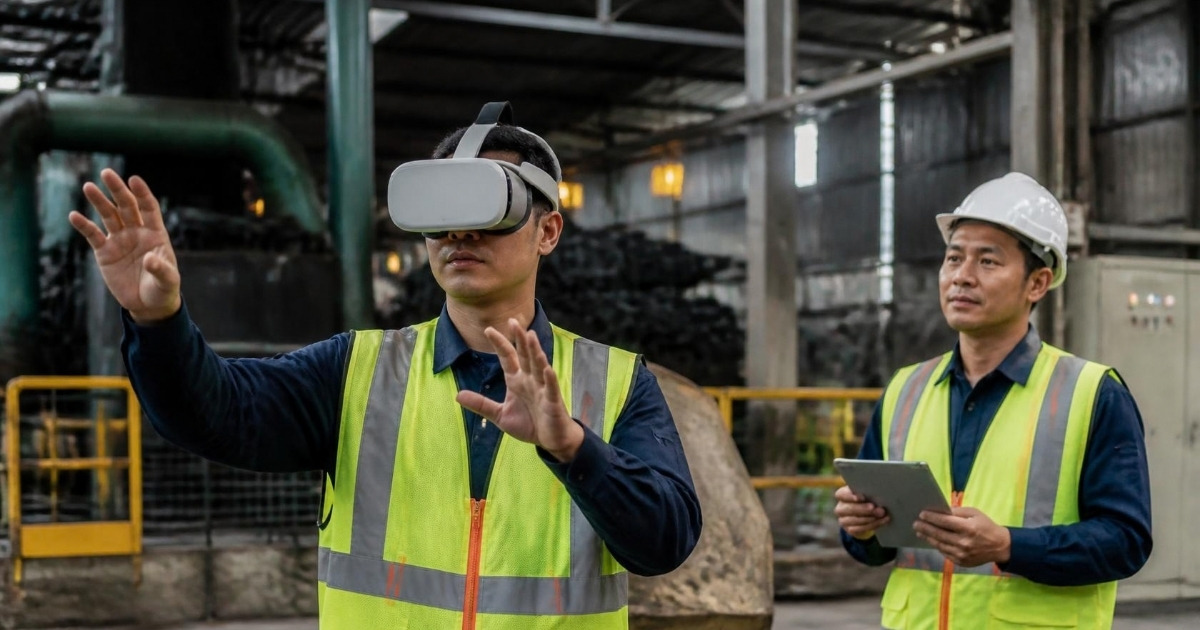
Indonesia recorded roughly 319,000 workplace accident claims in 2025, according to Kemnaker and BPJS Ketenagakerjaan data reported during Bulan K3 Nasional 2026 — and construction and manufacturing between them account for more than half of that total. Construction's largest single cause is falling from height; manufacturing's is machinery entrapment and failed lockout-tagout procedure. Virtual reality safety training addresses a specific slice of that problem: it lets a worker rehearse the exact hazardous scenario, inside a realistic version of the actual worksite, without the risk of a real fall or a real machine. It does not replace certification, PPE compliance, or supervision, and it is not the right format for every kind of safety training. What follows is where it genuinely fits, and where it does not.
What the 2025 numbers actually say
The headline figure — around 319,000 work accident cases for the year — is easy to read as a single statistic and move past. The breakdown is more useful. Reports citing Kemnaker and BPJS Ketenagakerjaan data put construction at roughly 29% of claims and manufacturing at roughly 26%, together accounting for more than half of all recorded incidents nationally, with East Java reporting the highest provincial caseload (GoodStats, citing BPJS Ketenagakerjaan).
Within construction, falls from height are the dominant cause — cited at around a quarter of incidents in that sector, followed by being struck by heavy objects or materials and scaffolding failures. Within manufacturing, the dominant risks are getting caught in or struck by machinery, lockout-tagout procedure not being followed, and prolonged exposure to excessive noise. Thousands of the 2025 cases nationally resulted in death or permanent disability (Indonesia Safety Center's 2026 K3 evaluation).
None of this is news to a plant manager or a site safety officer. What it argues for is more specific than "more training." It argues for training that rehearses the exact failure modes driving the numbers — a worker deciding whether it is safe to unclip from a lanyard, or checking whether a machine has actually been isolated before reaching in — rather than training that describes those failure modes in a slide deck.
Where classroom K3 training runs out of road
Indonesia's K3 certification system is not the problem here, and nothing here argues for skipping it — Kemnaker-mandated certification for general K3 officers, work-at-height, and confined space entry remains a legal requirement, and it teaches the regulatory and procedural knowledge a worker genuinely needs. The gap is what happens after the certificate is issued: does the worker recognise the hazard when it appears on their own site, under time pressure, in a way that looks slightly different from the training photo?
That recognition gap is a rehearsal problem, not a knowledge problem. A worker can pass a written test on fall-arrest procedure and still misjudge an anchor point on an unfamiliar roof, because the test never asked them to look at a real roof and decide. Practical drills close that gap, but staging a fall-from-height drill, a confined-space rescue, or a machine-isolation walkthrough on a live site is expensive, disruptive, and — for some scenarios — not something you can safely stage at all.
What VR training actually changes
The same triage question that applies to any immersive training project applies here: which part of the objective needs interactive 3D, which part needs a realistic captured environment, and which part is still better served by a classroom or a real drill.
| Training objective | What it genuinely needs |
|---|---|
| Recognising an unsafe anchor point, an unguarded edge, or a missing LOTO tag on a real layout | 360° capture of the actual site or a matching one — the point is spotting a real hazard, not a generic one. |
| Practising the physical sequence of clipping in, isolating a machine, or entering a confined space | Interactive 3D simulation, where the sequence of actions is the skill being assessed. |
| Rehearsing a scenario that cannot legally or safely be staged live (an actual fall, an actual machine failure, an actual gas leak) | Interactive 3D — this is the category VR training exists for. |
| Understanding regulation, reporting procedure, and the reasoning behind a standard | Certified classroom instruction — VR does not replace this, and should not try to. |
| Testing whether a worker can retrieve and apply a procedure under simulated pressure | Scenario design with scoring, layered on top of either a captured or a modelled environment. |
In practice, a manufacturing or construction safety program built this way tends to combine two things: a 360° walkthrough of the worker's actual plant or site — so the layout, equipment, and signage are the real ones, not a generic asset-library approximation — and interactive modules for the specific high-risk actions, like connecting a fall-arrest lanyard at height, verifying a LOTO tag before reaching into machinery, or checking a confined-space atmosphere reading before entry. Each module can be scored, and each score can be logged against the worker and the site, which is what turns a training session into an auditable record rather than an afternoon that happened.
What this does not solve
VR training does not fix a safety culture where shortcuts are tolerated, and it does not substitute for supervision, correctly specified PPE, or the legally required certification pathway. It also is not the right tool for every site: a workforce of a dozen people with low equipment turnover may get more value from better-run physical drills than from building a simulation. Where it earns its cost is scale and repetition — a contractor running the same fall-arrest induction across a dozen sites, or a manufacturer onboarding new line workers every quarter, where the alternative is either an inconsistent physical drill each time or no practical rehearsal at all.
Deciding if it is worth building
Three questions are usually enough to tell whether a VR safety module will pay for itself: does the same hazard-specific induction get repeated across multiple sites or a recurring intake of new workers; does the hazard being trained involve a scenario that is expensive, disruptive, or unsafe to stage physically each time; and is there a specific, named failure mode in your own incident log — not a generic "improve safety culture" goal — that the training is meant to close. Where the answer to at least two of those is yes, the case for building it is usually straightforward. Where it is closer to a single classroom session for a small team, conventional K3 training is likely the more sensible spend.
Working with InReality Solutions
InReality Solutions builds VR training programs for organisations across Indonesia, including immersive learning environments captured from real facilities rather than generic 3D asset libraries — the same approach behind our restaurant operations training work. For manufacturing and construction specifically, the starting conversation is about which hazards are actually driving your incident numbers, not which headset to buy. Read more on AR and VR for training and learning, see our virtual reality services, browse a related approach in our emergency response training work, or talk to our team in Jakarta.
Frequently Asked Questions
Does VR safety training actually reduce workplace accidents in Indonesia?
There is no published Indonesia-specific dataset yet that isolates VR training's effect on accident rates from every other variable on a site, so treat any specific percentage claim with caution. What is well established is the underlying training principle: rehearsing a hazardous decision in a realistic setting builds recognition that a written test or lecture does not, which is why VR is used for exactly the scenarios — falls from height, machine isolation, confined space entry — where a live physical drill is expensive or unsafe to repeat. It is one input into a safety program, not a standalone fix for an accident rate.
How much does VR safety training cost compared to standard K3 training in Indonesia?
Conventional K3 certification in Indonesia typically runs from around Rp 3 million to Rp 26 million per program depending on the certification type, provider, and duration. A VR training module is a separate, one-time build cost layered on top of — not instead of — that certification pathway, and it scales with how many hazard scenarios and site environments need to be captured or modelled. There is no single market rate for VR safety training in Indonesia yet; providers price by scope, which is why the right first step is a proposal built around your specific hazards and sites rather than a published rate card.
Does VR training replace mandatory K3 certification in Indonesia?
No. Kemnaker-mandated certification — for general K3 officers, work at height, confined space entry, and other regulated categories — remains a legal requirement and must be delivered through a licensed K3 training provider. VR training sits alongside that requirement as practical rehearsal, not in place of it.
What kind of safety scenarios are actually worth building in VR versus training with a physical drill?
Scenarios that are expensive, disruptive, or unsafe to stage repeatedly on a live site — an actual fall arrest, a machine failure, a confined-space rescue — are the strongest candidates, especially when the same induction needs to be repeated across multiple locations or a recurring intake of new workers. Scenarios that mainly require regulatory knowledge, or that involve a small, stable workforce with infrequent turnover, are usually better and more cheaply served by classroom instruction or a well-run physical drill.

Founder & Managing Director · LinkedIn
Ready to Build Your New Reality?
Tell us about your brand and goals — we'll show you what's possible.