AR for Sales & Marketing · 7 min read
WebAR for Manufacturing: 3D Product Demos for Industrial B2B Sales in Indonesia
What WebAR actually is, how industrial manufacturers use it to sell equipment that's too big or too far to ship, what the market data shows, and what a real project costs in Indonesia.
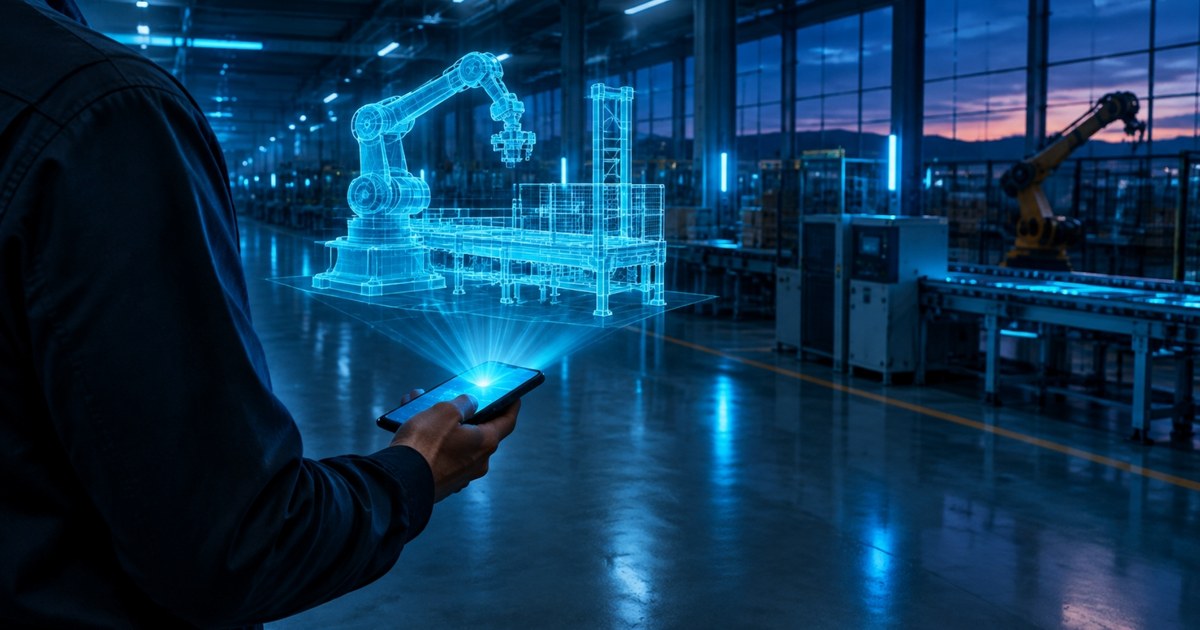
WebAR is turning into a practical sales tool for manufacturers and industrial equipment sellers in Indonesia, not just a marketing trick for consumer brands. When a product is too large, too expensive, or too far from the buyer to bring along — a packaging line, an excavator, a pump skid, a robotic arm — a WebAR demo puts a full-scale, interactive 3D version of that product in front of the buyer straight from a phone's browser, with no app to install. This guide covers what WebAR actually looks like for industrial B2B sales in Indonesia, what the market data shows about adoption, what a real project costs and takes, and the questions that separate a vendor who has shipped this work from one still pitching the concept.
What is WebAR, and why does it matter for industrial B2B sales?
WebAR (web-based augmented reality) lets a buyer tap a link or scan a QR code and see a life-size, interactive 3D model of a product placed in their own room through their phone's camera, with no app download required. For an industrial seller, it replaces a static spec sheet or a product video with something a prospect can walk around, open up and inspect before ever standing next to the real machine.
That matters most for anything too big, too far away, or too expensive to demo in person — which describes most industrial equipment. A buyer evaluating a packaging line or a piece of heavy machinery can rotate it, view it at true scale next to their own factory floor, or compare two configurations side by side, all from a meeting room or a trade-show booth.
Why a brochure photo or a spec-sheet PDF stops being enough
A flat photo or a PDF spec sheet tells a buyer the dimensions and the specs, but it doesn't answer the question that actually moves industrial deals forward: will this fit in my space, and how does it actually work? Heavy equipment and large production-line machinery can't be shipped to every sales meeting or regional trade show the way a consumer product can, and a short video walk-through still leaves the buyer looking at the seller's framing instead of exploring the product on their own terms.
That gap is exactly where augmented reality is being adopted across manufacturing. InReality Solutions already builds WebAR for brand and e-commerce sellers — see our AR for sales & marketing services and the WebAR work we've done for furniture and electronics retailers — and the same underlying technology applies directly to industrial product catalogs, just scaled to equipment instead of consumer goods.
How does an industrial WebAR demo actually get built?
3D modeling. Where a manufacturer already has CAD files or technical drawings, those usually convert directly into a lightweight 3D model — faster and more dimensionally accurate than modeling from photos alone. Where CAD isn't available, the product is modeled from reference photos and real measurements instead.
Choosing the trigger. A QR code on a brochure, a business card or a trade-show banner is the simplest and most flexible option: a prospect scans it and the AR experience opens immediately in their phone's own browser, no app store detour.
Device and field testing. This matters more for industrial use than for a retail campaign. A trade-show hall or a factory floor has worse lighting and a worse signal than a shopper's living room, so the experience needs testing under those real conditions, not just on one office Wi-Fi connection.
Analytics. Scan counts, time spent per session and which product configuration got viewed most are straightforward to track and worth asking for, since they tell a sales team which product angle is actually landing with buyers.
What does the data actually say about AR in manufacturing?
Augmented reality in manufacturing specifically — not AR overall — was valued at USD 26.48 billion in 2025 and is projected to reach USD 159.87 billion by 2035, a 19.7% CAGR, according to a Spherical Insights market report released in September 2026. The same report lists product design and visualization as one of the market's core application segments, alongside assembly guidance, quality inspection, training and remote collaboration — which is exactly the sales-enablement use case this guide is about, not just shop-floor tooling.
What results have other industrial companies seen with AR demos?
Public case studies from outside Indonesia give a sense of scale, even though neither is InReality's own work. Evapco, a heat-transfer equipment manufacturer, worked with AR developer JigSpace to replace physical equipment shipping at trade shows with portable 3D AR demos; according to the published case study, the company saved more than USD 500,000 by no longer shipping machines to events that each cost over USD 200,000 to attend, and equipped more than 100 sales reps with demos they could carry in a pocket.
Separately, industrial conglomerate Sumitomo worked with developer Gravity Jack on an AR trade-show app for machinery too large and heavy to bring to a booth, letting prospects view the equipment at scale and see its interior — a case study Gravity Jack published in December 2023. Neither case study reports a dollar figure for revenue impact, and results on any company's own campaign will depend on the product, the sales process and how well the demo is actually used in the room — which is exactly why it's worth asking a vendor for real numbers rather than a demo reel, something we cover in more depth in our AR vendor-selection guide.
What does an industrial WebAR project cost and take in Indonesia?
InReality Solutions prices WebAR experiences from Rp 25 juta, typically delivered in 2-3 weeks for a single product when CAD files or clear reference material are available. A catalog covering several SKUs, or a build that needs the product to be scanned rather than converted from CAD, takes longer and is quoted after a short technical brief, since the file quality a manufacturer can provide is usually the biggest factor in both cost and turnaround.
How do you choose a WebAR vendor for industrial equipment?
Can they work from CAD, or do they need the physical product on-site? A vendor who can convert existing CAD or technical drawings saves weeks compared to one who needs to scan or photograph the real machine.
Have they tested it in real field conditions? Ask whether the demo has actually been checked on a trade-show floor or a factory site, not only in a quiet office with strong Wi-Fi.
Is it WebAR, or does it need an installed app? An app download is the single biggest point of drop-off in front of a busy trade-show visitor or a buyer with five minutes between meetings.
Do they support the launch locally? For equipment being shown in Indonesia, a studio working in the same timezone with WhatsApp-reachable support matters more during a live event than it sounds on paper.
Is this only for large manufacturers, or does it work for mid-size industrial sellers too?
Often yes, scoped down. A single flagship product converted to WebAR is enough to test the idea at one trade show or with one key account before deciding whether to build out a full catalog — the same narrow-first approach we've written about for WebAR adoption in furniture and electronics retail and for AR packaging for B2B brands. Starting with the one product that already carries the most sales conversations is a reasonable way to see real engagement data before expanding further.
Sources
- Spherical Insights — Augmented Reality in Manufacturing Market Report, released September 2026
- CaseStudies.com / JigSpace — Evapco Saves $500,000+ With JigSpace
- Gravity Jack — AR's Impact on Trade Shows: A Manufacturing Case Study (Sumitomo), published December 2023
Frequently Asked Questions
Do buyers need to download an app to view a WebAR product demo?
No. WebAR runs directly in the phone's own browser after a link tap or QR scan, so there's no app store detour and nothing for the buyer to install. That's the main reason InReality builds industrial product demos as WebAR rather than as standalone apps.
Can a WebAR model be built from existing CAD files, or does the product need to be scanned?
Both are possible. Existing CAD files or technical drawings usually convert directly into a lightweight 3D model, which is faster and more dimensionally accurate. When CAD isn't available, the product can instead be modeled from reference photos and real measurements, though that route typically takes longer.
How much does an industrial WebAR project cost in Indonesia, and how long does it take?
InReality Solutions prices WebAR experiences from Rp 25 juta, typically delivered in 2-3 weeks for a single product with CAD or clear reference material available. A multi-SKU catalog or a build requiring physical scanning takes longer and is quoted after a short technical brief.
Does WebAR work without an internet connection on a factory floor or trade-show hall?
It needs a connection to load initially, but a well-built WebAR experience is optimized to load quickly even on the weaker WiFi or mobile signal typical of a trade-show hall or factory site — which is exactly why field testing under real conditions, not just office WiFi, matters before launch.
Is WebAR only useful at trade shows, or can a sales team use it in regular client meetings too?
It's useful in both settings. A sales rep can open the same WebAR link on a laptop or phone during a client visit, a video call, or a one-on-one meeting — anywhere showing the physical equipment isn't practical, not only on a trade-show floor.
What's the difference between WebAR and a 360° virtual tour for showing equipment?
WebAR overlays an interactive 3D model of a single product onto the buyer's own surroundings, which suits showing one machine or product line in detail. A 360° virtual tour instead lets a buyer walk through an entire space — a factory floor, a showroom or a facility — which fits better when the goal is showing a location rather than a single product.

Founder & Managing Director · LinkedIn
Ready to Build Your New Reality?
Tell us about your brand and goals — we'll show you what's possible.