Virtual Reality · 7 min read
VR Training for Property Sales Teams in Indonesia: Cost, Evidence and What It Fixes
What the research actually shows about VR training for property sales teams in Indonesia — realistic costs, the sales scenarios worth building, and what it doesn't replace.
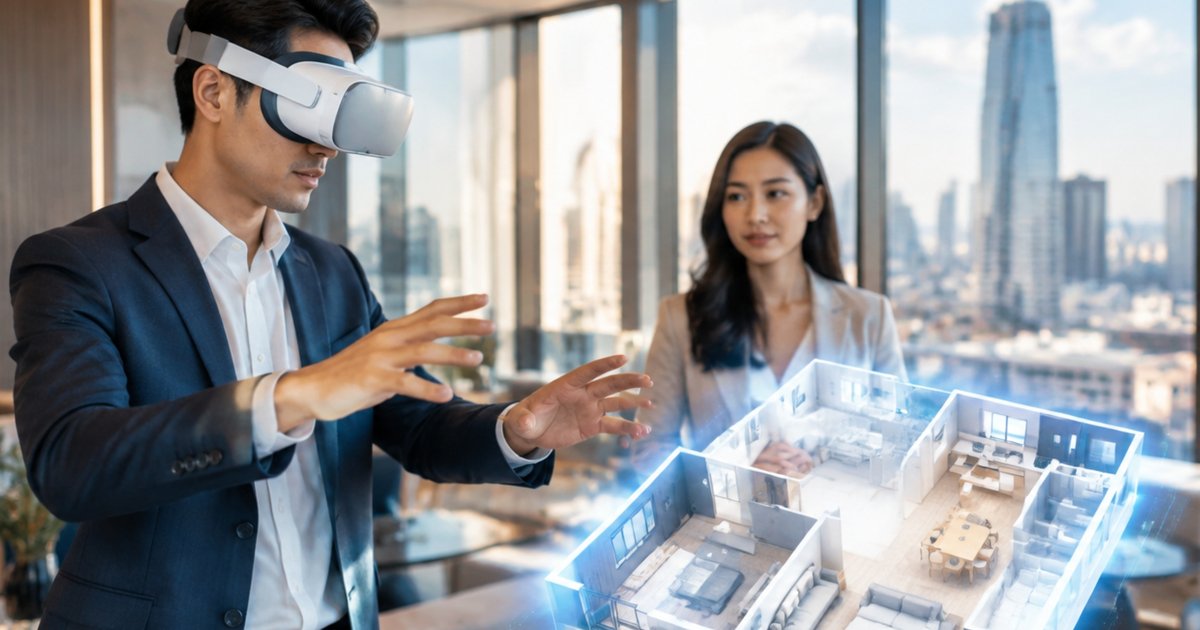
Indonesia's primary housing market contracted 25.67% year-on-year in the first quarter of 2026, after growing 7.83% the quarter before (Bank Indonesia, Residential Property Survey, Q1 2026). When fewer leads come through the door, a developer's sales team can't afford to keep learning its pitch on live prospects. VR training for property sales teams in Indonesia is getting serious attention for exactly this reason: it lets agents rehearse objection handling, VR-tour walkthroughs for remote buyers, and pre-launch show-unit pitches before they face a real buyer. This is what the format actually costs to build, what the evidence says it changes, and what it still doesn't replace.
Why Indonesian property developers are looking at VR training now
A sales team usually learns its pitch by giving it, which is a reasonable approach when leads are plentiful and a few rough conversations don't matter much. It is a worse approach when primary-market sales have just contracted by a quarter in a single year and every walk-in or WhatsApp enquiry has to count. Bank Indonesia's Q1 2026 survey also found the contraction was uneven by unit size — small units fell 45.59% year-on-year while medium units actually grew 8.28% — which means a developer's sales script increasingly has to work harder for a narrower, more deliberate buyer rather than a high-volume one. That is the kind of buyer a sales team should be well-rehearsed for before meeting them, not after.
Does VR help sell property, and does that mean VR training helps too?
Yes, with a caveat: peer-reviewed research shows VR property tours shorten time-on-market, but the same study found no effect on selling price, and it measured tours shown to buyers, not training given to agents. VR tours and VR training solve different problems, and the research on each is different. A 2025 study in Information Systems Research found that VR property tours shorten how long a listing stays on the market — functioning as what the authors call an "efficiency enhancer" — particularly for higher-value, higher-involvement units and in cases where the live selling agent's own service quality is weaker (Yan, Meng & Tan, Information Systems Research, 2025). The study did not find that VR tours raise the selling price itself — its effect is on speed, not value.
That last finding is the actual case for VR training: if a listing with a weaker-performing agent still benefits from a VR tour, a better-trained agent running that same tour should perform even better, not worse. Separately, Matterport data reported by HousingWire ties an interactive 360° tour to a 95% increase in the likelihood a homebuyer contacts the listing agent (Prakkat, HousingWire, 2023). A tour that drives that many more contacts only pays off if the agent fielding them already knows how to run the conversation — which is what training, not the tour itself, is for.
What VR sales training actually changes — and what it doesn't
It changes how fast and how confidently an agent can rehearse a high-stakes, scripted conversation before facing a real buyer; it doesn't replace relationship-building, reading a specific buyer in the room, or the judgment built from closing real deals. PwC's 2020 study of enterprise VR soft-skills training — run across February 2019 to January 2020 — found VR learners completed training 4 times faster than classroom learners and felt 3.75 times more emotionally connected to the material than classroom learners did (PwC, 2020). The same study found VR reaches classroom-equivalent cost at around 375 learners and beats e-learning cost past roughly 1,950 learners — in other words, the economics favor VR as a sales team grows past a single branch office.
What VR training is actually good at is letting an agent rehearse a scripted, high-stakes interaction — a price objection, a buyer stalling, a walkthrough of a unit that only exists as a floor plan — as many times as needed, without needing a real prospect, a finished show unit, or a senior salesperson's time for every run-through. It is not good at replacing the relationship-building, the reading of a specific buyer's hesitation in the room, or the judgment a salesperson only develops by closing real deals over time. No training module removes the need for that; it just means an agent arrives at their first real conversation having already rehearsed the mechanics.
Sales scenarios worth building in VR for property teams
Four scenario types are worth prioritising for a property sales team specifically:
Objection handling and negotiation — price pushback, "I need to think about it," and competing-project comparisons, scripted against your actual pricing and payment-scheme policy so an agent has already practiced staying on-script under pressure.
Live VR-tour walkthroughs — training agents to actually run a 360° virtual tour as a guided sales conversation rather than a passive link they send and hope the buyer clicks, which matters most for the remote and overseas buyers a tour is built to reach in the first place.
Pre-launch show-unit rehearsal — letting a sales team walk a VR-captured unit and practice the pitch before the physical show unit is finished, which is exactly the window — pre-launch — when a developer most needs its team ready.
Multi-project consistency — for a developer running several launches at once, rehearsing the same pitch standard in VR keeps sales messaging consistent across sites without flying a sales trainer to every project for every new intake of agents.
How InReality builds it, and what it costs
We don't start a VR sales-training project by talking about headsets. We start with a walkthrough of your actual floor plans, unit types and the sales script your team already uses, because a generic 3D show unit trains an agent to describe a layout that isn't the one buyers will actually walk into. The environment is built using the same 360° capture process behind our virtual tours for property businesses, scripted against your real objection-handling flow, piloted with a small group of agents, and adjusted before a full rollout across the sales team. Cost depends on how many unit types and scenarios need to be captured; our pricing page has the starting ranges for immersive training builds, and a proposal is scoped to your actual launch rather than a flat rate.
How to choose a VR training vendor for a property sales team
Four questions are worth asking any vendor before committing to a build:
Is the unit captured from your actual floor plan, or a generic template? An agent who rehearses in a layout that doesn't match the real unit is learning the wrong landmarks and the wrong talking points.
What device does this run on? A standalone headset gives a more immersive rehearsal; a phone-based setup is cheaper to roll out across a larger sales team but more limited in interaction.
How do you measure whether it worked? Ask whether the vendor scores an agent's responses or simply plays a passive walkthrough — the former gives sales management something to actually track against performance.
What does it cost to update when pricing or the unit mix changes? A module that needs a full rebuild every time a price list changes is a materially different ongoing cost than one built to be edited.
Working with InReality Solutions
InReality Solutions builds VR training environments for organisations across Indonesia, captured from real floor plans and facilities rather than generic asset libraries — the same production approach behind our hotel staff training and manufacturing safety training work. For a property developer's sales team, the starting conversation is about which part of your pitch is costing you the most in missed or mishandled conversations, not which headset to buy. See our virtual reality services, browse our 360° virtual tours, or talk to our team in Jakarta.
Frequently Asked Questions
Does VR training increase property sales close rates in Indonesia?
No published study measures VR training's effect on close rates specifically. What the 2025 Information Systems Research study (Yan, Meng & Tan) measured is that VR property tours shorten time-on-market, especially for high-value units and when live agent service quality is weaker. VR training's realistic contribution is making agents better at running that VR tour and handling the objections it surfaces — not a guaranteed lift in conversion.
How much does VR training cost for a property sales team in Indonesia?
There is no single published market rate for Indonesia. PwC's 2020 enterprise VR training study found VR training reaches classroom-equivalent cost at roughly 375 learners and beats e-learning cost past about 1,950 learners, which is a useful way to think about team size versus build cost — not a quote. A module's price depends on how many unit types, scenarios and sales offices need to be captured; our pricing page has starting ranges, and a proposal is scoped to your actual sales process.
What sales scenarios are worth building in VR versus role-play training?
Scenarios that are hard to repeat safely or consistently with a real prospect — price objections, a buyer stalling on a decision, walking a remote or overseas buyer through a unit that doesn't physically exist yet — are strong candidates, because VR lets a new agent rehearse them as many times as needed before a real sales conversation. Relationship-building and reading a specific buyer's mood are still better learned on the floor.
Can VR training replace a physical show unit entirely?
No. It replaces the stage where a new agent first learns the floor plan, the pitch and the objection-handling script, so they aren't learning it for the first time in front of a paying prospect. It doesn't replace the final in-person site visit, the physical materials and finishes a serious buyer wants to touch, or the judgment that comes from closing real deals over time.
How long does it take to build a VR sales training module for a property launch?
It depends on scope. A single unit type with a core walkthrough-and-objection scenario is a realistic size for a first module; a multi-tower launch with several unit types and a full negotiation script takes longer. The first step is a walkthrough of your actual floor plans and sales script so the build can be scoped before a timeline is quoted.

Founder & Managing Director · LinkedIn
Ready to Build Your New Reality?
Tell us about your brand and goals — we'll show you what's possible.