Virtual Reality · 7 min read
VR Training for Hotel Staff in Indonesia: Cost and What It Fixes
VR training for hotel staff in Indonesia: what it costs, which scenarios are worth it, and what it doesn't replace.
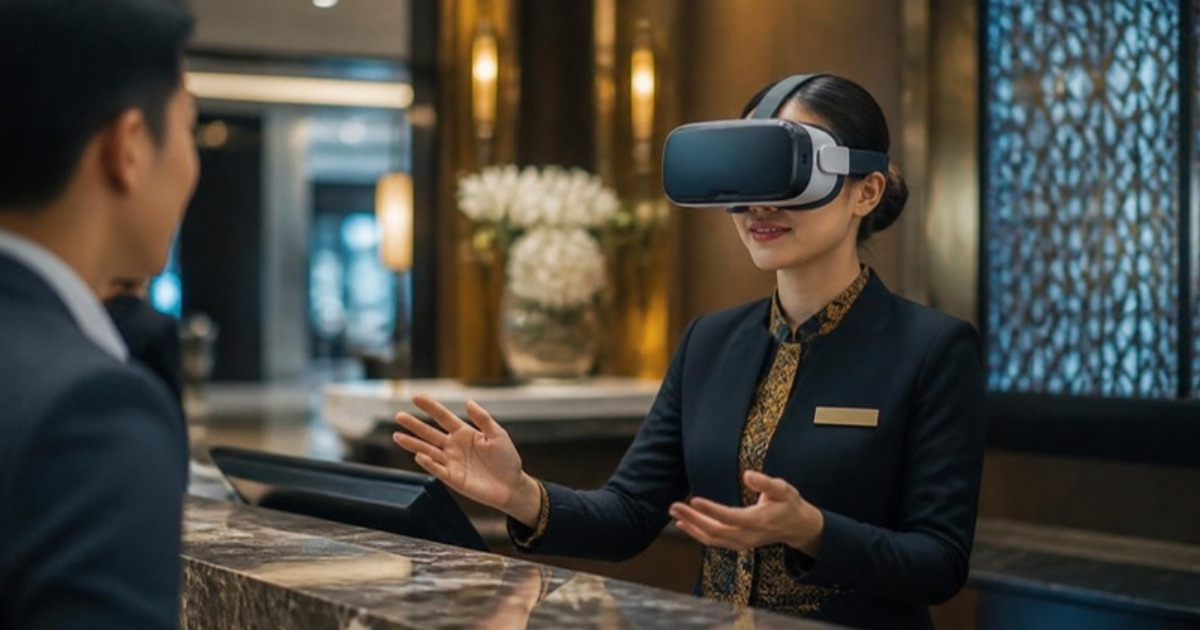
VR training is moving from factory-floor safety drills into Indonesia's hospitality industry, where front-desk and guest-service roles carry some of the highest repeat-training costs in the business. A 2019 Telkom University study on VR-based front-desk officer training put the cost of a single conventional training session, per employee, at around Rp 6.5 million — and hotels pay that figure over and over as staff turn over (Prawita, Ramdani & Rizkyani, e-Proceeding of Applied Science, 2019). This is what VR training for hotel staff in Indonesia actually involves: what a module costs to build, which scenarios are worth it, and what the format does not replace.
Why hotels keep re-paying for the same training
Most training budgets are built around a one-time cost. Hotel front-desk and guest-service training rarely works that way, because the people doing the job change more often than the job itself does. A 2020 study on human capital issues in Indonesia's hotel industry, based on interviews with hotel operators, named retention as one of the persistent top-line challenges facing the sector, alongside recruitment and competition for skilled staff (Thio & King, Petra Christian University, 2020). When a property retrains its front desk every time someone leaves, the real cost of training is not the Rp 6.5 million for one session — it is that figure multiplied by however many times a year the role turns over.
This is the actual business case for VR training in hospitality: not that it is a more exciting format, but that it is cheaper to repeat. A classroom session needs a trainer's time, a training room taken out of use, and new printed materials every time a procedure changes. A VR module, once built, is the same marginal cost to run for the fifth new hire as it was for the first.
What conventional front-desk training actually costs
The Telkom University figure — about Rp 6.5 million per person per session, covering instructor time and facility use — lines up with what most Jakarta hotels would recognise as a realistic in-person training cost once a trainer's day rate, materials and the opportunity cost of pulling a trainee off the floor are counted. That same research built and tested a prototype system, Front.O VR, covering three scenarios specifically: taking a direct reservation, check-in, and check-out, using 360° video with voice-recognition scoring of the trainee's spoken responses on a mobile VR headset (Prawita, Ramdani & Rizkyani, 2019). It is a useful reference point for scope: three core front-desk scenarios, not an entire onboarding curriculum, is a realistic size for a first VR training build.
What VR training changes — and what it doesn't
VR training is good at one specific thing: letting someone rehearse a scripted interaction — a difficult guest, a double-booked room, a complaint at checkout — as many times as needed, without needing a real guest, a real actor, or a real hotel lobby taken offline to do it. That repeatability is the entire value case.
It is not good at replacing the parts of the job that depend on reading an actual person in the moment, knowing the specific quirks of one property, or the supervised, corrected practice a new hire gets shadowing a senior colleague on a real shift. No VR module removes the need for that on-the-job mentoring; it just means the trainee arrives at it having already rehearsed the mechanics, instead of learning them for the first time in front of a paying guest.
Scenarios worth building for hotel teams
Based on what has actually been built and published in this space, and on the kinds of recurring situations hotel teams describe as hardest to train for, four scenario types are worth prioritising:
Front-desk procedure — reservation handling, check-in, and check-out, the same three scenarios the Telkom University prototype targeted, and still the highest-frequency interaction most hotels need new staff to get right fast.
Service recovery — a guest complaint, an overbooking, or a billing dispute, rehearsed with a scripted escalation path so a new hire has already practiced staying calm and following the property's actual policy before facing it for real.
Emergency response — fire, medical incident, or evacuation procedures specific to the property's own layout, which is the same underlying production approach behind our emergency response training work for other sectors.
Multi-property consistency — for a group running several properties, rehearsing the same standard of guest interaction in VR is a way to keep service consistent across locations without flying a trainer between sites for every new cohort.
How InReality builds it, and what it costs
We do not start a VR training project by talking about headsets. We start with a walkthrough of the actual front-desk and guest-service workflow at your property — the real layout, the real scripts your team already uses, the real situations that come up most often — because a VR environment captured from a generic template teaches a trainee to recognise a room that is not theirs. The scenarios get scripted against your actual service standard, built as a 360°-captured environment using the same production process behind our hotel virtual tour work, piloted with a small group of staff, and adjusted before a full rollout. Cost depends on how many scenarios and how many property layouts need to be captured; our pricing page has the starting ranges for immersive training builds, and a proposal is built around your specific scope rather than a flat rate card.
How to choose a VR training vendor
Four questions are worth asking any vendor before signing off on a hotel VR training build:
Is the environment captured from our actual property, or a generic 3D template? A trainee who rehearses in a room that doesn't match the real lobby is learning the wrong landmarks.
What device does this run on? A standalone headset (Quest-class) gives a more immersive experience; a phone-and-cardboard setup like the one in the Telkom University prototype is cheaper to deploy across a larger team but more limited in interaction.
How do you measure whether it worked? Ask whether the vendor scores trainee responses (as the Front.O VR prototype did with voice recognition) or simply plays a passive scenario — the former gives you something to actually track.
What does it cost to update when a procedure changes? A module that requires a full rebuild every time your check-in script changes is a different ongoing cost than one built to be edited.
Working with InReality Solutions
InReality Solutions builds VR training environments for organisations across Indonesia, captured from real facilities rather than generic asset libraries — the same approach behind our manufacturing safety training and restaurant operations training work. For a hotel or hospitality group, the starting conversation is about which guest-service situations are actually costing you the most in repeat training, not which headset to buy. See our virtual reality services, browse our 360° virtual tours for hotels, or talk to our team in Jakarta.
Frequently Asked Questions
Does VR training reduce hotel staff turnover in Indonesia?
Not directly — no published study links VR training to lower turnover specifically. What it does is lower the cost of training the replacements turnover creates: once a module is built, retraining the next new hire costs far less staff time and trainer availability than running another in-person session from scratch. It addresses the expense of turnover, not the turnover itself.
How much does VR training cost for hotel staff in Indonesia?
There is no single published market rate. As a reference point, a 2019 Telkom University study priced conventional in-person front-desk training at about Rp 6.5 million per employee per session; a VR module is a separate build cost on top of that, scaling with how many scenarios and property layouts need to be captured. Ask any vendor for a scoped proposal rather than a flat rate.
What hotel scenarios are worth building in VR versus role-play training?
Scenarios that are hard to repeat safely or practically with a live guest or actor — a difficult complaint, an overbooking, an emergency evacuation — are strong candidates because VR lets a trainee rehearse them as many times as needed. Day-to-day soft skills that depend on reading a real person's mood are still better learned through supervised, on-the-job practice.
Can VR training replace in-person hospitality training entirely?
No. It replaces the part of training where a new hire first learns a scripted procedure, so they are not learning it for the first time in front of a paying guest. It does not replace supervised shadowing on a real shift, property-specific knowledge, or the judgment that comes from handling real guests over time.
How long does it take to build a VR training module for a hotel?
It depends on scope. A build covering the Telkom University prototype's scale — three core front-desk scenarios — is a reasonable size for a first module; a multi-property rollout with service-recovery and emergency scenarios takes longer. The first step is a walkthrough of your actual front-desk workflow so the scope can be scoped properly before a timeline is quoted.

Founder & Managing Director · LinkedIn
Ready to Build Your New Reality?
Tell us about your brand and goals — we'll show you what's possible.