Virtual Tours · 6 min read
Virtual Tours for Hotels in Indonesia: Selling Rooms Before the Grand Opening
Indonesia's hotel pipeline is expanding past Bali into Jakarta, Surabaya, Semarang and beyond. Here's how 360° virtual tours help new hotels sell rooms before opening day.
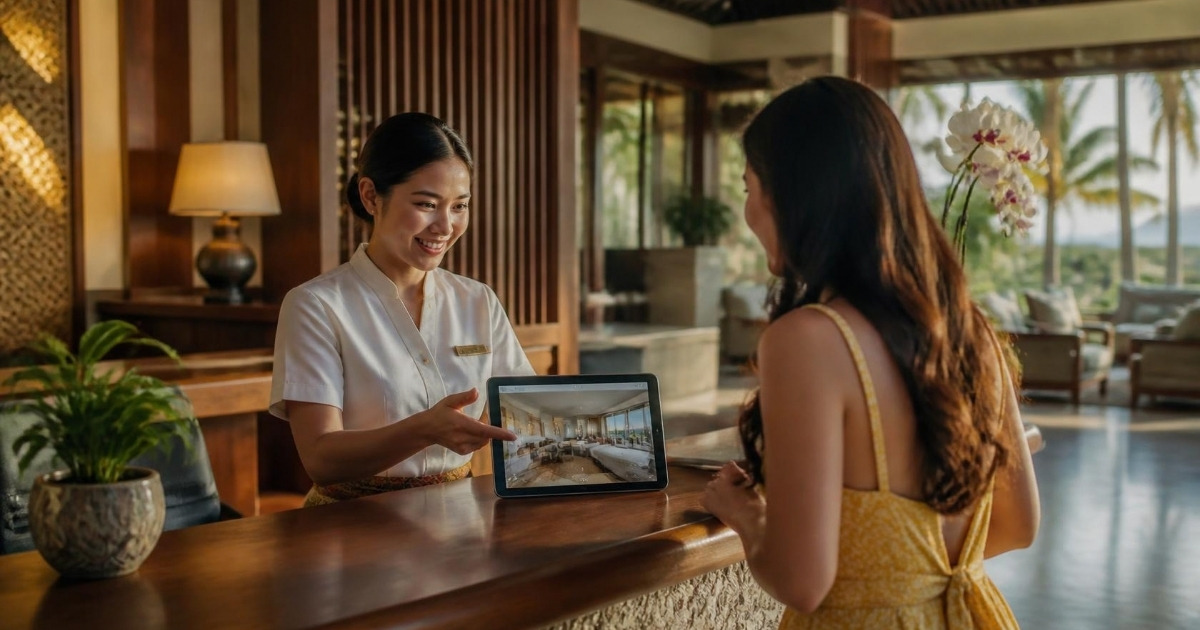
Indonesia's hotel construction pipeline reached 189 projects and 31,772 rooms as of the second quarter of 2026 — up 12% by project count and 8% by room count year-on-year, according to a September 2026 Southeast Asia hotel industry report from Leading Hoteliers. Jakarta alone accounts for 47 of those projects and 10,140 rooms, driven by business travel, long-stay demand and branded residences. But the growth isn't confined to the capital, and it isn't confined to Bali either.
Openings confirmed for 2026 stretch across the country. JW Marriott Surabaya and Semarang Marriott both sit in the same pipeline tracked in that report, alongside voco Bali Seminyak. Further out, the Grand Hotel De Djokja in Yogyakarta is completing a restoration this year, and the Art Deco Grand Hotel Preanger in Bandung reopens in August 2026, according to Tatler Asia's roundup of Indonesia's 2026 hotel openings. Even Rote Island — a name that rarely turns up in hospitality headlines — gets a new property this year in Nihi Rote & Hospitality Academy.
What connects a business hotel in Jakarta to a restoration project in Yogyakarta and a new resort on Rote Island is a scheduling problem every one of them shares. A hotel needs revenue before its doors open — corporate accounts, travel-agent allocations, OTA contracts, MICE bookings, sometimes an entire soft-launch calendar of events — and almost none of the people making those decisions will get on a plane to inspect a property that isn't finished yet.
The pre-opening sales problem
For a single independent hotel with a local owner nearby, that's a minor inconvenience. For a group opening across several cities in one year, or courting corporate accounts headquartered in Singapore, Tokyo or the Middle East, it's a genuine sales bottleneck. Static renders and a handful of photographs are what most pre-opening hotels have to offer a distant buyer, and they carry a credibility problem of their own — everyone who has shopped for a hotel room assumes a render flatters the space more than the finished room will.
It stands to reason that a corporate travel manager or wedding planner who can only see a handful of curated photographs is working with far less information than one who has actually walked through the lobby, a sample room and the event space — even if that walkthrough happens on a laptop screen rather than in person. The gap between "I saw photos" and "I explored it" is exactly what a pre-opening property needs to close before the property itself exists to visit.
What a 360° virtual tour actually changes
A 360° virtual tour lets a buyer move through a hotel's lobby, room types, restaurant, pool deck and event spaces remotely, at their own pace, without waiting for a fam trip or a site visit that a new property usually can't host yet anyway. The features that matter most for a pre-opening hotel are the ones that turn a passive walkthrough into something closer to a real inspection:
- Menu-based navigation so a MICE planner can jump straight to the ballroom and skip past the rooms they don't need to see.
- Day and night modes so an event planner can judge what the pool deck or rooftop bar actually looks like after dark, not just in daylight renders.
- Multilingual versions of the same tour, which do double duty: they serve buyers from different markets in their own language, and the presence of several language options is itself a small signal to a prospective guest that people from their part of the world are already interested in the property.
- Live guided tour sessions, where a sales contact walks a corporate buyer or travel agent through the actual property in real time over a video call — the closest a pre-opening hotel can get to hosting a site inspection before it can host one.
None of this replaces an actual stay once the hotel opens. What it does is give distant decision-makers enough confidence to say yes to a contract, an allocation, or a booking months before they could otherwise justify it.
Training staff before the building is fully staffed
A new hotel opening also has to solve a second, related timing problem: it needs a trained team on day one, but the property, its systems and its service standards are often only coming together in the weeks before launch. For a group opening several properties in the same year, sending trainers to physically walk every new hire through every space, repeatedly, across every city, is exactly the kind of recurring cost that doesn't scale.
This is where the same underlying capture technology extends into VR staff training. InReality Solutions has already applied this approach in hospitality — simulating a multi-brand restaurant group's real locations in VR rather than rebuilding them as animated environments, specifically to make practical training reproducible across many sites without reproducing its cost each time. The same logic applies directly to a hotel: a 360° capture of the finished lobby, a guest room, the back-of-house service corridor or the front desk becomes a training environment new staff can rehearse in before the property is even open to guests — see our breakdown of VR training for hotel staff in Indonesia, including cost and which scenarios are worth building. Read more on AR and VR for training and learning.
What makes a pre-opening tour actually work
A handful of practical choices separate a pre-opening virtual tour that gets used from one that just exists as a link nobody visits:
- Capture in stages, not all at once. Start with whichever spaces are finished first — usually a show room, the lobby and one F&B or event space — and extend the tour room-type by room-type as construction and fit-out progress, rather than waiting for 100% completion.
- Sequence by what buyers actually decide on. A leisure traveler wants to see the room and the pool. A MICE planner wants the ballroom, breakout rooms and loading access. Structure the navigation menu around those different buyer journeys, not just a floor-by-floor walk.
- Pair the tour with a live session for named accounts. For the handful of corporate accounts or travel agencies that matter most to opening-year revenue, a scheduled live-guided walkthrough closes more doubt than a self-serve link ever will.
- Keep it live as the property changes. A tour captured six weeks before opening and never revisited starts to look stale fast. Refreshing key spaces once the interior styling is finalized keeps the tour honest.
InReality Solutions builds 360° virtual tours and immersive VR training for hospitality, property and enterprise clients across Indonesia, from Jakarta to secondary cities. If a property is opening this year and the sales conversations have already started, the useful first step is talking about which spaces need to be captured first — see our 360° virtual tour services, the property virtual tour pricing guide, or get in touch with our team in Jakarta.
Frequently Asked Questions
How much does a 360° virtual tour cost for a hotel in Indonesia?
Hotel virtual tours are usually priced the same way property tours are: per panorama, with the total driven by how many rooms, room types, and public spaces (lobby, restaurant, pool, event space) need to be captured. A boutique property with a handful of room categories costs meaningfully less than a large-format hotel with dozens of distinct spaces. InReality Solutions' property virtual tour pricing guide breaks down what drives that number in more detail.
Should a hotel start its virtual tour before or after opening?
Before, if the goal is to influence pre-opening sales. Capture usually happens once show rooms, the lobby, and at least one event or F&B space are fit out, even if other floors are still under construction. The tour can then be extended room-type by room-type as more of the property is finished, so it is live and usable months before the grand opening rather than arriving after the sales conversations that mattered most have already happened.
Do virtual tours actually influence corporate and MICE bookings, or only leisure travelers?
Both, but for different reasons. A leisure traveler is deciding whether to book a room. A MICE planner or corporate travel manager is often deciding whether to commit a multi-year contract, a conference allocation, or a company's entire regional travel policy to a property — a higher-stakes decision that is harder to make from photographs alone. A live-guided virtual tour session, where a sales contact walks the buyer through the actual event space and room blocks in real time, gives that buyer something closer to a site inspection without requiring one.
Can a virtual tour be made of a hotel that's still under construction?
Yes, in stages. Capture typically starts with whichever spaces are complete first — a finished show room, the lobby, a sample of the standard room type — and expands as construction and fit-out progress. This staged approach is common for pre-opening hotels because it lets the property start selling against real, photographed spaces rather than waiting for 100% completion.
What's the difference between a virtual tour and VR training for hotel staff?
A virtual tour is built for guests, buyers and partners to explore a property remotely, usually viewed on a phone or laptop through a web link. VR staff training uses the same underlying 360° capture technology but is built for new employees to rehearse service standards, table settings, room layouts and brand-specific procedures inside a headset, before or alongside on-the-job training. They serve different audiences, but for a hotel opening across multiple cities in the same year, capturing once and using the footage for both purposes is a natural efficiency.

Founder & Managing Director · LinkedIn
Ready to Build Your New Reality?
Tell us about your brand and goals — we'll show you what's possible.