Virtual Tours · 9 min read
Property Virtual Tour Pricing in Indonesia: What It Costs and What Actually Sells Units
What a property virtual tour costs in Indonesia, why it is priced per panorama, and what separates a tour that closes units from one that just exists.
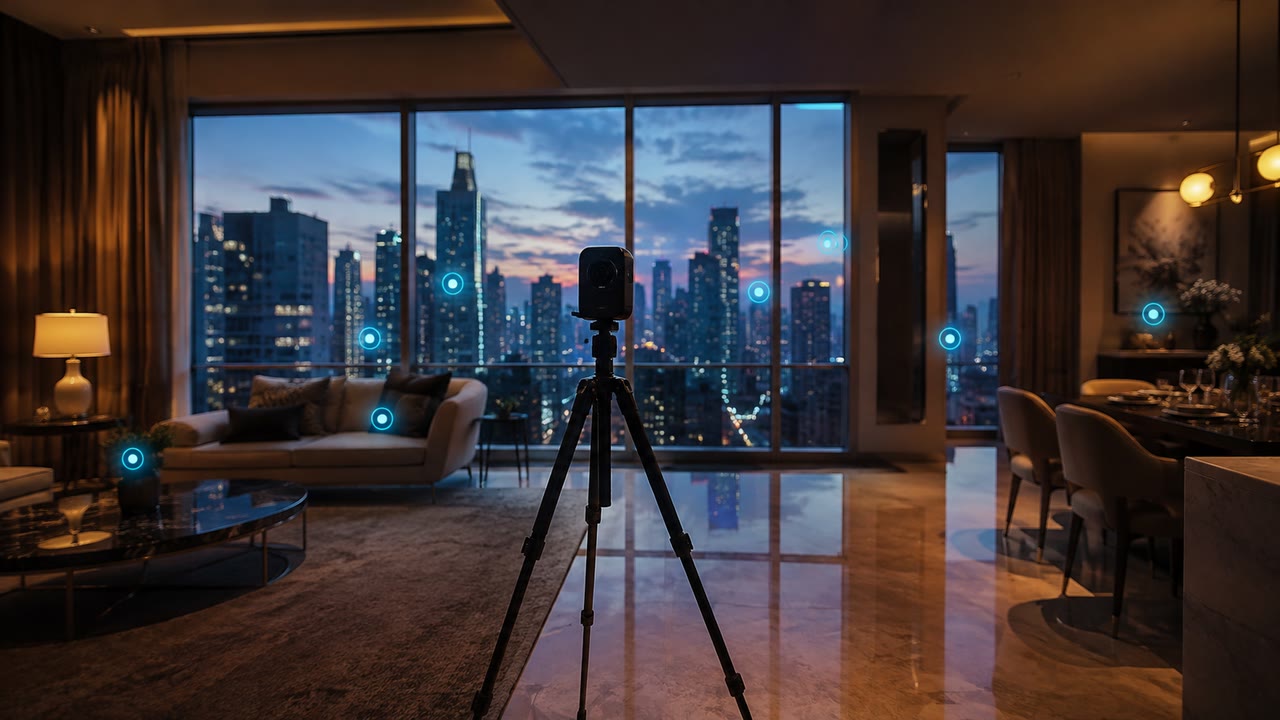
Every developer asking about virtual tour pricing has been quoted two very different numbers. One vendor wants a few hundred thousand rupiah per unit type. Another wants ten times that. Both call the deliverable a virtual tour, and from a line item in a marketing budget they look interchangeable.
They are not. One of them is a set of linked photographs. The other is a sales tool your agents will open in front of a buyer every week for the next three years. This guide explains how property virtual tours are priced in Indonesia, what sits inside a professional figure, and how to tell from a quotation which one you are being sold.
The short answer
For a professionally built property virtual tour, expect roughly Rp 2,000,000 to Rp 3,000,000 per panorama. That band assumes properly designed hotspots, a custom interface skin in the developer's brand, an app-like browsing experience, and a build planned and executed by developers who have shipped tours like it before.
Quotations well below that band are common. What they typically buy is photography and a stitching tool — not a sales instrument. The difference does not show up in the screenshots. It shows up in whether anyone uses it after launch.
Why property tours are priced per panorama
Because the panorama is the unit of work, and it is the only unit that scales honestly. Each position is a discrete job: tripod placed, exposures bracketed, the frame cleared, the operator painted out of the nadir, the image stitched, colour-matched to its neighbours, then linked and hotspotted inside the tour.
Pricing per unit type breaks immediately — a studio might need four panoramas and a penthouse fourteen. Pricing per square metre is worse, because a show unit and an empty corridor of the same area are not the same work. Day rates price the photographer's time rather than the finished asset, and what a developer is buying is the asset.
How many panoramas does a property project need?
Panorama count follows the buyer journey you want to build, not the floor area. These are real counts from tours we have delivered, which is a more useful guide than a formula:
| Project | Panoramas | Scope |
|---|---|---|
| VYNE at Graha Raya | 10 | A single unit type, sold entirely from photorealistic renders |
| LRT City Jati Bening | 23 | Off-plan apartment, 60% of it facilities and public areas |
| Manhattan Times Square Medan | ~45 | Mixed-use tower, 15 individually owned apartments at launch |
| Pesona Indah, Cluster Eropa | 46 | Three property types across one residential cluster |
| The Sanctuary Collection | 180 | Three property clusters in a single connected experience |
| Pakubuwono Residence | 220 | Full luxury residential estate, units plus every facility |
Multiply your realistic count by the band above and you have a working budget before you request a single quotation. That changes the conversation from "how much is a virtual tour" to "here is our scope, price it" — a much harder question for a vendor to answer vaguely.
More panoramas is not better. A tour with 40 well-chosen positions outsells one with 90 that leaves a buyer lost. What you are buying is a route through the property, not coverage of it.
What the professional band includes — and what it does not
| Normally inside a per-panorama rate | Normally quoted separately |
|---|---|
| On-site capture, bracketed exposures, operator removal, stitching, colour matching | 3D renders for units that do not physically exist yet |
| Navigation hotspots and the movement logic between positions | Voice-over narration and background music licensing |
| Information hotspots carrying unit sizes, specs and facility details | Translation of tour content into additional languages |
| Custom interface skin in the developer's brand | CRM or lead-capture integration beyond a standard enquiry form |
| Floorplan or masterplan navigation between units and clusters | Annual hosting after the included period, and later content updates |
| Mobile, tablet and desktop behaviour, plus embedding on the project site | VR headset builds for the marketing gallery |
Ask every vendor to mark which column each line falls in. The gap between a cheap quotation and a professional one is usually not the headline rate — it is that half the left column has quietly moved right, or disappeared.
What a cheap tour actually costs you
A cheap tour is not a smaller version of a good one. It is a different product. The low end of the market delivers competent panoramas linked together and nothing else: no designed opening view, no information where a buyer needs it, no thought about how someone moves through the property. It exists so the project can say it has one.
The clearest evidence we have for the size of that gap comes from a client who had already commissioned one. The Sanctuary Collection replaced an existing virtual tour and measured five times the engagement of the one it replaced, alongside a 1.5× improvement in closing rates. Same property, same buyers — a different build. Royal Sumatra's Cluster Grandis saw the same 5× multiple against a conventional website landing page.
The wasted fee is the smaller loss. The larger one is that the project now believes it has a virtual tour, and the case for building a real one becomes very hard to make for the next two years.
What "well planned" means for a property tour
Almost all of the difference is decided before anyone picks up a camera. Beautiful panoramas are the floor. A tour built by people who have done this before is thinking about:
- Buyer psychology. Where does someone land, and what do they see first? A tour opening on an empty corridor or a blank wall loses people in five seconds. The opening frame is a design decision, not whichever panorama happens to be numbered one.
- The journey through the property. A physical site visit has a sequence — arrival, facilities, unit, view — and that sequence is how agents sell. A tour that lets buyers teleport anywhere can destroy it, or, built well, can preserve it while still letting a returning buyer jump straight to the unit they are deciding on.
- The information a buyer needs at each point. Standing in a living room, what do they actually ask? Ceiling height, unit size, which way it faces, what is on the floor above, what the service charge covers. Anticipating those questions and putting the answer one tap away is what turns a panorama into a sales conversation.
- Access to the material that closes. Floorplans, specification sheets, payment schedules, handover timelines, distance to transit. A good tour opens a route into that depth for the serious buyer without burying the browsing one.
- Who else is using it. An agent presenting on a tablet in the marketing gallery, a buyer revisiting alone at 11pm, a family member overseas who will never see the site, a broker forwarding a link. Four different journeys through one asset — and the good tours are built knowing all four exist.
None of this appears in a quotation. All of it appears in the tours a vendor has already built, which is why the portfolio matters more than the proposal.
Selling units that do not exist yet
Off-plan is where a virtual tour earns its fee most obviously, and it is priced differently. When there is nothing to photograph, panoramas are produced as photorealistic 360° renders from the architectural models — a different production line from a camera shoot, usually quoted per render rather than inside the capture rate.
It works. LRT City Jati Bening launched with 23 rendered environments and zero physical units in existence. VYNE at Graha Raya produced 10 rendered panoramas and reported three confirmed sales within three months where the tour was instrumental, with two more in down payment.
If you already hold 3D assets from your architect, say so early — Royal Sumatra built a complete platform covering five unit types with no new renders commissioned at all. Existing assets can move a project a long way down the cost curve.
What moves the price
- Renders versus photography. Off-plan units need 3D production; completed show units need a shoot. Many projects need both, and they are priced separately.
- Depth of information. Three hotspots per room is a different build from twenty carrying specs, floorplans and payment terms.
- Number of unit types and clusters. Each type is its own path through the tour, and a masterplan tying clusters together is additional navigation design.
- Existing assets. Usable architectural models, renders or floorplans reduce production materially.
- Integration. Embedding on the project site is standard. Pushing enquiries into your CRM with tour context attached is development work.
- Update cycle. Show units get re-dressed and phases launch. Agree the rate for adding a cluster later at the start, not as a series of small separate jobs.
Questions to ask before you sign
None of these are technical, and they separate vendors quickly.
- May I see three property tours you have built, and speak to one of those developers?
- What is the opening view, and why that one?
- Can you show engagement data from a tour you delivered — not visits, but interactions per user?
- Who hosts it, for how long, and what does year two cost?
- When we launch the next cluster, what does adding it cost?
- Do we own the panoramas and renders, or only the assembled tour?
The third question is the sharpest. A vendor who has never measured whether their tours get used will not have an answer. For reference, Pakubuwono Residence records more than 50 click interactions per active user, and CitraIndah City more than 40 with an average engagement time of a minute and a half. Those are the numbers that tell you a tour is being used rather than merely visited.
How long it takes
Most property tours run between one and three months end to end, and the variable is rarely the photography. Cluster Eropa went from assets to full launch in 28 days with 46 panoramas delivered. Larger builds take longer: The Sanctuary Collection, at 180 panoramas across three clusters, ran to three months.
What sets the schedule is how quickly unit specifications, floorplans and pricing are confirmed on your side, and how many rounds of approval the interpretive content goes through. Agree that workflow at kickoff and the timeline holds.
Getting a scoped quotation
InReality Solutions is a Google Street View Trusted and Matterport partner, and has delivered virtual tours for developers including Pakubuwono, Agung Sedayu Group, Agung Podomoro Land, LRT City and Royal Sumatra. If you want a figure for your project rather than a band, the fastest route is a scoping call — we work out the panorama count with you and quote against it.
Read our guide to producing a property virtual tour for the workflow behind this, see how developers use virtual tours and our property case studies, or talk to our team in Jakarta.
Frequently Asked Questions
How much does a property virtual tour cost in Indonesia?
For a professionally produced tour, budget roughly Rp 2,000,000 to Rp 3,000,000 per panorama. That band assumes designed navigation and information hotspots, a custom interface skin in the developer's brand, an app-like experience across mobile and desktop, and an experienced build team. Panorama counts vary widely with scope: a single unit type may need around 10, an off-plan apartment about 23, a residential cluster with three property types around 46, and a full luxury estate 200 or more. Multiplying your realistic count by that band gives a working budget before you request quotations.
Is a virtual tour priced per unit, per square metre, or per panorama?
Per panorama, in any serious quotation. Per-unit pricing breaks down immediately because a studio might need four panoramas and a penthouse fourteen. Per-square-metre is worse, since a furnished show unit and an empty corridor of the same area involve very different work. Day rates price the photographer's time rather than the finished asset, and a developer is buying the asset. Each panorama is a discrete unit of work — setup, bracketed capture, operator removal, stitching, colour matching and hotspot linking — so it is the only unit that scales honestly.
Can you build a virtual tour for a property that has not been built yet?
Yes, and it is one of the strongest uses of the format. Where there is nothing to photograph, panoramas are produced as photorealistic 360° renders from the architectural models. LRT City Jati Bening launched with 23 rendered environments and no physical units in existence at all, and VYNE at Graha Raya produced 10 rendered panoramas and reported three confirmed sales within three months where the tour was instrumental. Renders are usually quoted separately from photographic capture, and existing 3D assets from your architect can reduce that cost substantially.
Why are some property virtual tour quotations so much cheaper?
Because they are for a different product. The low end of the market delivers panoramas linked together and little else — no designed opening view, no information hotspots where a buyer needs them, no custom interface, no thought about how someone moves through the property. The photography is often fine. What is missing is the design work that turns images into a sales tool. The Sanctuary Collection replaced an existing virtual tour with a properly built one and measured five times the engagement and a 1.5x improvement in closing rates on the same property.
How long does a property virtual tour take to produce?
Typically one to three months end to end, depending on scale. Pesona Indah's Cluster Eropa went from assets to full launch in 28 days with 46 panoramas delivered; The Sanctuary Collection, at 180 panoramas across three clusters, ran to about three months. The photography is rarely the constraint. What sets the schedule is how quickly unit specifications, floorplans and pricing are confirmed on the developer's side, and how many approval rounds the tour content goes through.

Founder & Managing Director · LinkedIn
Ready to Build Your New Reality?
Tell us about your brand and goals — we'll show you what's possible.